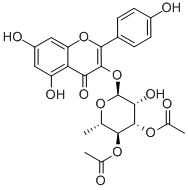
The p90 ribosomal S6 kinases (RSK) 1-4 are downstream members of the extracellular signal-regulated kinase (ERK)/MAPK cascade. SL 0101-1 is a kaempferol glycoside, isolated from the tropical plant F. refracta, that selectively inhibits RSK2 with an IC50 value of 89 nM (Ki = 1 μM) without interfering with upstream activators of RSK, including ERK, MEK, EGFR, and PKC. At 100 μM, SL 0101-1 inhibits the proliferation of MCF-7 breast cancer cells, arresting cells in the G1 phase of the cell cycle. SL 0101-1 has been used to characterize the intracellular signaling events associated with angiotensin II-induced tyrosine kinase activation with a concentration of 30 μM attenuating angiotensin II-induced cell proliferation.
SL 0101 is a potent and selective inhibitor of p90 Rsk, without inhibiting the function of upstream kinases such as MEK, Raf, or PKC.
Selective inhibitor of p90 ribosomal S6 kinase (RSK) (IC 50 = 89 nM for RSK2). Does not inhibit upstream kinases such as MEK, Raf and PKC. Inhibits the growth of MCF-7 human breast cancer cells with no effect on the normal breast cell line.
[1] JEFFREY A. SMITH. Identification of the first specific inhibitor of p90 ribosomal S6 kinase (RSK) reveals an unexpected role for RSK in cancer cell proliferation.[J]. Cancer research, 2005, 146 1: 1027-1034. DOI:
10.1158/0008-5472.1027.65.3[2] MICHAEL D GODENY Peter P S. ERK1/2 regulates ANG II-dependent cell proliferation via cytoplasmic activation of RSK2 and nuclear activation of elk1.[J]. American journal of physiology. Cell physiology, 2006, 291 6: C1308-17. DOI:
10.1152/ajpcell.00618.2005