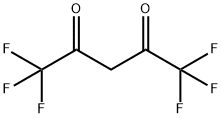
HEXAFLUOROACETYLACETONE acts as a chelating ligand. For example, it can forms metal-chelate complexes with Ca(II), Zn (II), Cu(II), Ni(II), Co(II), Nd(III), Rh(III), Fe(III) and Cr(III), making it be useful in extracting related metal ions. It can also be used as liquid crystal intermediate.
Chattoraj, S. C., A. G. C. Jr, and R. E. Sievers. "Cadmium and zinc chelates of hexafluoroacetylacetone the gas phase reaction of a novel volatile cadmium complex with hydrogen sulphide." Journal of Inorganic & Nuclear Chemistry 28.9(1966):1937-1943.
Tomazic, Branko B., and J. W. O'Laughlin. "Synergic extraction of iron with hexafluoroacetylacetone and tributyl phosphate." Analytical Chemistry 45.8(2002):1519-1526.
http://www.sigmaaldrich.com/catalog/product/aldrich/238309?lang=en®ion=US
https://www.alfa.com/zh-cn/catalog/L01693/
clear colorless to slightly yellow liquid
1,1,1,5,5,5-Hexafluoro-2,4-pentanedione acts as a chelating ligand. It is used as liquid crystal intermediate.
Hexafluoroacetylacetone forms metal-chelate complexes with Cu(II), Ni(II), Co(II), Nd(III), Rh(III), Fe(III) and Cr(III). Hexafluoroacetylacetone on hydration yields 1,1,1,5,5,5-hexafluoropentane-2,2,4,4-tetraol.
The general procedure for the synthesis of 1,1,1,5,5,5-hexafluoroacetylacetophenone from 1,1,1,5,5,5-hexafluoroacetylacetophenone dihydrate was as follows: 6.8 g (69 mmol, 4.9 eq.) of concentrated sulfuric acid was slowly added to 3.4 g (14 mmol, 1 eq.) of 1,1,1,5,5,5-hexafluoroacetylacetophenone dihydrate at 10 °C. The reaction mixture was stirred at room temperature for 3 hours and 35 minutes and the formation of a two-phase system was observed. Upon completion of the reaction, the mixture was left to stratify and the dehydrated organic phase was separated to obtain the dehydrated organic phase. 2.7 g of the target product 1,1,1,5,5,5-hexafluoroacetylacetone was finally obtained in 93% yield. The structure of the product was confirmed by 1H-NMR and 19F-NMR: 1H-NMR [internal standard: (CH3)4Si, deuterated solvent: CD3CN] δ 10.45 (2H); 19F-NMR [internal standard: CFCl3, deuterated solvent: CD3CN] δ -77.18 (6F).
It forms a dihydrate which has no UV spectrum compared with �max (CHCl3) 273nm ( 7,800) for the anhydrous ketone. The dihydrate decomposes at ~90o. The hydrate (10g) plus anhydous CaSO4 (Drierite, 30g) are heated and distilled, the distillate is treated with more CaSO4 and redistilled. When the distillate is treated with aqueous NaOH and heated, the dihydrate crystallises on cooling. The Cu complex has m 135o (after sublimation). [Gilman et al. J Am Chem Soc 78 2790 1956, Belford et al. J Inorg Nucl Chem 2 11 1956, Beilstein 1 IV 3681.]
[1] Patent: US6384286, 2002, B1. Location in patent: Page column 5-6
[2] Patent: US6384286, 2002, B1. Location in patent: Page column 5
[3] Patent: US6384286, 2002, B1. Location in patent: Page column 4 - 5