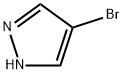
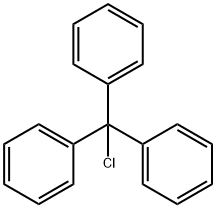
To a 500 mL Schlenk flask pre-displaced with nitrogen was added 4-bromo-1H-pyrazole (10.0 g, 68.0 mmol) and anhydrous tetrahydrofuran (250 mL). After cooling the reaction system to 0°C, 60% sodium hydride dispersion (3.3 g, 81.6 mmol) was slowly added. After the hydrogen release stopped, triphenylchloromethane (20.9 g, 74.8 mmol) was slowly added and the reaction mixture was stirred at room temperature overnight. Upon completion of the reaction, the reaction was quenched with deionized water (5 mL) and subsequently dried under vacuum. The resulting residue was ground with dichloromethane (5 mL) and treated with methanol (200 mL) for 2 hours. The resulting suspension was filtered and dried at 50°C overnight to give 4-bromo-1-trityl-1H-pyrazole (26.0 g, 66.8 mmol, 98.2% yield) as a white solid. The product was characterized by 1H NMR (300 MHz, DMSO-d6) with chemical shifts of δ = 7.03-7.06 (m, 6H), 7.34-7.40 (m, 9H), 7.51 (s, 1H), 7.76 (s, 1H).