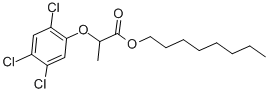
Fenoprop-isoctyl was produced through a classic “ester of an ester” route that mirrored other phenoxy herbicide derivatives of its era. Manufacturers began with technical-grade fenoprop, itself obtained by chlorinating and then etherifying the appropriate phenolic precursor to install the 2-propyl side chain. Once purified, this phenoxy acid was esterified with iso-octanol under controlled, typically acid-catalysed conditions, using heat and continuous water removal to drive the reaction forward while avoiding decomposition of the phenoxy structure.
White solids. Primary hazard is to threat to the environment. Immediate steps should be taken to limit spread to the environment. Burn, though may be difficult to ignite. Used as herbicides and plant growth regulators.
Slightly soluble in water.
Esters react with acids to liberate heat along with alcohols and acids. Strong oxidizing acids may cause a vigorous reaction that is sufficiently exothermic to ignite the reaction products. Heat is also generated by the interaction of esters with caustic solutions. Flammable hydrogen is generated by mixing esters with alkali metals and hydrides.
INHALATION: Vapors or mists may be irritating to nose and throat. EYES: Mild irritation. SKIN: Irritation-slight to moderate. INGESTION: Weakness, lethargy, anorexia, diarrhea, spasticity, possible death due to ventricular fibrillation and subsequent cardiac arrest.
Synthetic auxin affecting nucleic acid biosynthesis and cell elongation. Systemic, selective.
Herbicide; Plant Growth Regulator