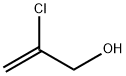
1, in 2000 ml reaction bottle, add 2.1 mol sodium carbonate and 1300 ml water, then add 3.5 mol 1,2-dichloropropene (396 g, content of 98%), while stirring and heating reflux, gas chromatography monitoring 1,2-dichloropropene content of less than 2% when the end of the reaction. After the reaction was finished, the reaction was separated into layers, and the upper and lower layers were separated by a separatory funnel to obtain the upper layer of 2-chloro-2-propen-1-ol aqueous solution of 1178.8g, and the upper layer of 2-chloro-2-propen-1-ol aqueous solution was divided into four equal portions evenly, i.e., each portion of 294.7g.
2. The first portion was extracted with ethyl acetate and a centrifugal extractor, and the parameters of the extractant were set at 68.58 Hz and 0.2 V, and the flow rate of extractant was controlled at 19 ml/ml, and the extractant flow rate was controlled at 19 ml/ml, and the extractant flow rate was controlled at 19 ml/ml. The flow rate of the extractant was controlled at 19 ml/min, the flow rate of 2-chloro-2-propen-1-ol aqueous solution was 48 ml/min, and four extractors were connected in series to realize continuous extraction.
3, distillation of the reaction solution after extraction, recovery of extractant and separation and purification of the product, the collection of 53-55 fraction, the gas phase detection content are more than 99%, the fraction for the recovery of the extractant, and continue to raise the temperature, the collection of 143-145 fraction. The first distillation of the extractant as ethyl acetate yielded 38.2 g of 2-chloro-2-propen-1-ol product.