An ester and alcohol. Esters react with acids to liberate heat along with alcohols and acids. Strong oxidizing acids may cause a vigorous reaction that is sufficiently exothermic to ignite the reaction products. Heat is also generated by the interaction of esters with caustic solutions. Flammable hydrogen is generated by mixing esters with alkali metals and hydrides. Flammable and/or toxic gases are generated by the combination of alcohols with alkali metals, nitrides, and strong reducing agents. They react with oxoacids and carboxylic acids to form esters plus water. Oxidizing agents convert them to aldehydes or ketones. Alcohols exhibit both weak acid and weak base behavior. They may initiate the polymerization of isocyanates and epoxides. TOXICITY - Alcohols and polyols vary widely in toxicity. Among the most toxic are methyl and allyl alcohol, which act as nervous system depressants.
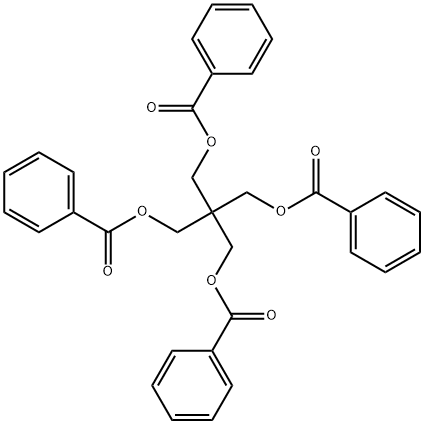
5.0 mL of dichlorosulfoxide (45 mol) and 4 g (26 mol) of benzoylformic acid were added to a dry three-necked flask, then 30 mL of toluene was added as a solvent, and 2 drops of N,N-dimethylformamide were added, and the reaction was completed under N2 gas protection by constant stirring and heating and refluxing for 4 h in a water bath at 40 C until no gas was released from the air guide of the drying tube above the condenser tube and, at 70 C, the reaction was The reaction was finished, and the crude product was obtained by rotary evaporation at 70. The crude product was recrystallized from dichloromethane to give 2.4 g of benzoylcarbonyl chloride as a yellow powdery solid.0.136 g (0.8 mol) of pentaerythritol was weighed and dissolved in 30 mL of dichloromethane, and then added to a dry three-necked flask.0.158 g (1.6 mol) of triethylamine was added.0.708 g (4 mol) of benzoylcarbonyl chloride was dissolved in a mixed solution of 30 mL of dichloromethane. A mixed solution of 0.708 g (4 mol) benzoylcarbonyl chloride dissolved in 30 mL of dichloromethane was added dropwise to the above reaction system, and the reaction was heated and refluxed under the protection of N2 gas at 40 with stirring for 5 h. At the end of the reaction, the filtrate was filtered, the filtrate was washed with saturated sodium bicarbonate solution and deionized water for 3 times each, dried with anhydrous magnesium sulfate, filtered, and the organic phase was further purified by column chromatography, wherein the unfolding agent in the silica gel column was V (petroleum ether) V (ethyl acetate) = 2:1, and finally The yellow liquid pentaerythritol tetraphenyl ester was obtained as 0.575 g, with a yield of 86.51% (in terms of pentaerythritol).