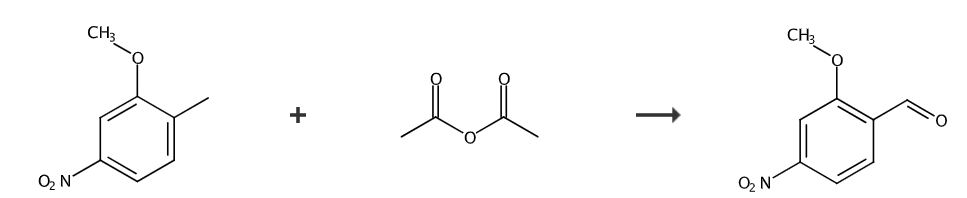
Step 1: Preparation of 4-nitro-2-methoxy-(α,α-diacetoxy)toluene:
Add 150.0 g (0.8973 mol), 900 mL of HOAc, and 900 mL of Ac2O to a 5 L three-necked round-bottom flask equipped with a mechanical stirrer. Stir the mixture and cool to 8 °C with acetone/ice bath. Carefully add 136 mL of concentrated H2SO4 while keeping the reaction temperature below 19 °C.
After cooling to 0°C, CrO
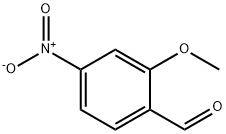
sub>3 (252.6 g, 2.526 mol, 2.815 equivalents) was added in portions over 1 hour while maintaining the reaction temperature between 0 and 10°C. After the addition was complete, the mixture was stirred at 0°C for 30 minutes, at which point the reaction was complete. The reaction mixture was then carefully poured into ice (1.5 kg) with stirring to obtain a slurry. The remaining black, gelatinous residue was washed with HOAc (3 x 100 mL), and the washings were added to the slurry. After stirring for 10 minutes, the slurry was filtered. The filter cake was washed with water (3 x 400 mL) and dried under vacuum for 17 hours to obtain compound 4-nitro-2-methoxy-(α,α-diacetoxy)toluene (129.0 g, 51%). Step 2, Preparation of 2-methoxy-4-nitrobenzaldehyde: Compound 4-nitro-2-methoxy-(α,α-diacetoxy)toluene (250.7 g, 0.8851 mol), dioxane (300 mL), and concentrated HCl (60 mL) were placed in a 2 L round-bottom flask equipped with a condenser and a mechanical stirrer. The reaction mixture was heated to reflux and stirred under N2 for 20 hours. Water (250 mL) was added dropwise while keeping the reaction mixture under reflux. After cooling to 0 °C in an ice/water bath, the resulting slurry was stirred for 30 minutes and then filtered. The filter cake was washed with water (4 × 200 mL) and dried under vacuum for 17 hours to give compound 2-methoxy-4-nitrobenzaldehyde (146.3 g, 91%) as a yellow solid.