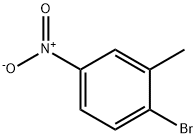
1 mol of o-bromotoluene, 20 g of dried acid saponin and isobutanol were added to a reactor equipped with a water separator, 1,2-dibromoethane was used as solvent, and concentrated nitric acid was added dropwise at 83 for 4 h at this temperature.
The reaction was carried out at 83 for 4 h. The synergistic catalytic nitrification with acid saponite and isobutanol showed an increase in the ratio of 5 isomers with the same amount of nitric acid on the one hand, and an increase in the ratio of 5 isomers on the other hand.
On the one hand, the ratio of 5 isomer increased under the same dosage of nitric acid, which was probably caused by the reaction of isobutanol with concentrated nitric acid to form alkyl nitrate, which selectively catalyzed o-bromotoluene on the surface of acidic saponite;
On the other hand, the addition of isobutanol resulted in a significant decrease in the nitrification conversion of o-bromotoluene, which was due to the somewhat poorer activity of the alkyl nitrate ester relative to concentrated nitric acid. Although the rate of nitrification is faster at high temperatures in high concentrations, nitric acid is volatile and decomposes to produce
NO 2 gas, reduce the concentration of nitric acid and increase the reaction time can improve the nitrification conversion rate. When the concentration of nitric acid is 98%, the amount of nitric acid is 1.5 for o-bromotoluene.
When the nitric acid concentration is 98% and the amount of nitric acid is 1.5 times that of o-bromotoluene, the nitrification conversion rate can reach 100%, and the proportion of the 5-position isomer 2-bromo-5-nitrotoluene is 70.1%.