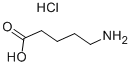
LIGHT PINK CRYSTALLINE POWDER
5-Aminovaleric Acid Hydrochloride is used in the synthesis of precursors and fragments of antibiotics XIV and in the study of the reaction of thiolactams with ethyl chloroacatate. Reagent in the preparation of hydroxymethyl dihydroisoxazole derivatives useful as antibiotics agents.
reaction type: solution phase peptide synthesis
There are three main biosynthetic pathways for 5-aminopentanoic acid: the enzyme-catalyzed pathway, the whole-cell-catalyzed pathway and the fermentation pathway. The conversion solution of 5-aminopentanoic acid obtained by the enzyme-catalyzed pathway was NH4HCO3 solution at pH 7.8, and the conversion solution also contained a small amount of the substrate lysine and the product 5-aminopentanoic acid; the conversion solution of 5-aminopentanoic acid obtained by whole-cell-catalyzed method contained about 14 g/L phosphate buffer solution, about 2 g/L sulfate, and a small amount of lysine and glucose; the conversion solution of 5-aminopentanoic acid obtained by fermentation method contained about 10 g/L phosphate, about 2 g/L sulfate, and about 2 g/L glucose. The fermentation broth of 5-aminopentanoic acid obtained by the fermentation method contained about 10 g/L of phosphate, about 16 g/L of sulfate, and a small amount of remaining glucose and lysine; the 5-aminopentanoic acid was separated by an ion exchange resin using a method for separating -aminobutyric acid, which was subjected to flocculation and filtration for removing bacterial organisms, and a large-pore adsorption resin for decoloration, and finally the 5-aminopentanoic acid was separated by an ion exchange resin.
Crystallise the salt from CHCl3. Otherwise dissolve it in EtOH and add 2 volumes of Et2O and chill. [Schniepp & Marvel J Am Chem Soc 57 1557 1935, Woods & Colver J Am Chem Soc 67 654 1945, Beilstein 4 III 1343, 4 IV 2636.]