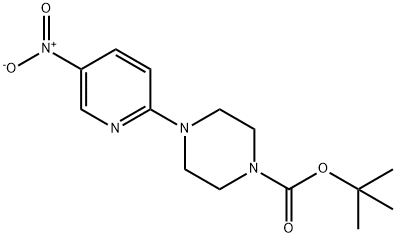
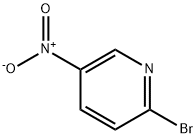
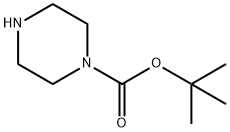
General procedure: 2-bromo-5-nitropyridine (11.39 g, 56.1 mmol), tetrabutylammonium iodide (TBAI) (1.04 g, 0.05 mmol), potassium carbonate (8.53 g, 61.7 mmol), and N-BOC-piperazine (11.5 g, 61.7 mmol) were dissolved in DMSO (100 mL) and gently heated to 50 °C. The reaction was carried out for 3 h, followed by cooling to room temperature overnight. The reaction mixture was diluted with EtOAc (200 mL), filtered to remove the salt, and the DMSO solution was obtained by evaporating the EtOAc. The solution was diluted with water to form a precipitate. The precipitate was collected by filtration, washed with water and dried under vacuum to give 1-tert-butylcarbonyl-4-(5-nitro-2-pyridyl)piperazine (16.1 g, 93%) as a light orange solid.1H NMR (400 MHz, CDCl3) δ ppm 1.47 (s, 9H), 3.55 (m, 4H), 3.75 (m, 4H), 6.55 (d, J = 9.3 Hz, 1H), 8.21 (dd, J = 9.5, 2.7 Hz, 1H), 9.03 (d, J = 2.7 Hz, 1H). 1-tert-butylcarbonyl-4-(5-nitro-2-pyridinyl)piperazine (16.0 g, 51.9 mmol) was dissolved in THF (400 mL), Raney nickel (4 g) was added, and the reaction was carried out for 5 hr under 50 psi hydrogen atmosphere. The catalyst was removed by diatomaceous earth filtration and the solvent was evaporated in vacuum to give 1-tert-butylcarbonyl-4-(5-amino-2-pyridyl)piperazine (14.5 g, 100%).1H NMR (400 MHz, CDCl3) δ ppm 1.46 (s, 9H), 3.31 (m, 6H), 3.53 (m, 4H), 6.56 (d, J = 8.8 Hz. 1H), 6.98 (dd, J = 8.8, 2.9 Hz, 1H), 7.78 (dd, J = 2.9, 0.7 Hz, 1H). m/z 279.1 (M + 1).