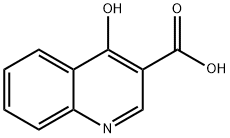
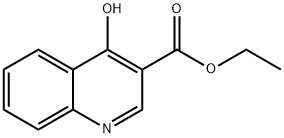
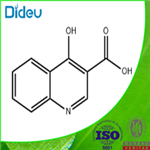
The general procedure for the synthesis of 4-hydroxyquinoline-3-carboxylic acid from ethyl 4-hydroxyquinoline-3-carboxylate was as follows: ethyl 4-hydroxyquinoline-3-carboxylate (1.2 g, 5.5 mmol) was dissolved in 20 mL of ethanol, followed by the addition of 0.1 g/mL of aqueous sodium hydroxide (6.6 mL, 16.5 mmol). The reaction was carried out under reflux conditions for 3 hours. Upon completion of the reaction, the reaction solution was cooled to 20 °C and the pH was adjusted to 4 with 4 mol/L hydrochloric acid, at which point a solid precipitated. After recovering about 10 mL of solvent ethanol by decompression distillation, the solid was collected by filtration. The solid was washed with a mixture of ethanol and water (2 mL x 2 times) and finally dried to give 0.96 g of 4-hydroxyquinoline-3-carboxylic acid in 92% yield and the product was an off-white solid.
[1] Molecular Crystals and Liquid Crystals Science and Technology Section A: Molecular Crystals and Liquid Crystals, 2000, vol. 344, p. 163 - 168
[2] Chemistry of Heterocyclic Compounds (New York, NY, United States), 1995, vol. 31, # 2, p. 167 - 175
[3] Khimiya Geterotsiklicheskikh Soedinenii, 1995, # 2, p. 195 - 203
[4] Patent: CN106187887, 2016, A. Location in patent: Paragraph 0015; 0048; 0049; 0050; 0051; 0052; 0053
[5] Journal of the American Chemical Society, 1946, vol. 68, p. 1264