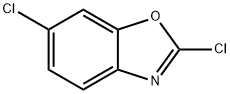
2,6-Dichlorobenzoxazole is used in the synthesis of 2-(3-(2,6-dichloro-4-(3,3-dichloroallyloxy)phenoxy)propoxy)-5-(trifluoromethyl)benzo[d]oxazole, an insecticide against Spodoptera exigua.
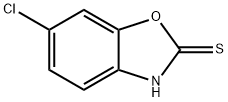
General procedure for the synthesis of 2,6-dichlorobenzoxazole from 6-chlorobenzo[d]oxazole-2(3H)-thione: In a 500-mL four-neck reaction flask, 50 g (0.27 mol) of 6-chlorobenzo[d]oxazole-2(3H)-thione, 300 mL of toluene, and 40 g (0.135 mol) of tris(trichloromethyl)carbonate were added. The reaction mixture was slowly warmed to 50°C and the temperature was continued at a rate of 0.5°C/min, holding the temperature for 10 minutes after each 10°C increase. When the temperature reached 105°C, the reaction was maintained for 1 hour. Upon completion of the reaction, the solvent was removed by distillation under reduced pressure (the initial vacuum was maintained at -0.07 MPa, and when the temperature was raised to 100°C-110°C, the vacuum was increased to -0.095 MPa to completely evaporate the solvent). After evaporation, the residue was removed while hot and cooled and crystallized to give 50.82 g of 2,6-dichlorobenzoxazole with a product purity of 98.1% and a molar yield of 98.4%.
[1] Patent: CN102432559, 2016, B. Location in patent: Paragraph 0020; 0037; 0038
[2] Patent: WO2018/37223, 2018, A1. Location in patent: Page/Page column 197; 198
[3] Bioorganic and Medicinal Chemistry Letters, 2006, vol. 16, # 7, p. 1975 - 1980
[4] Journal of Organic Chemistry, 2009, vol. 74, # 8, p. 3229 - 3231
[5] Bioorganic and Medicinal Chemistry Letters, 2012, vol. 22, # 9, p. 3044 - 3049