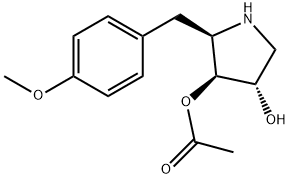
Anisomycin (22862-76-6) activates JNK/SAPKs and reduces c-fos and c-jun. Protein synthesis inhibitor. Anisomycin induces apoptosis and sensitizes cells to anoikis. Cell permeable.
It is applied as an antiparasitic agent and antineoplastic agent. It acts as a protein synthesis inhibitor (blocks translation), potent activator of stress-activated protein kinases (JNK/SAPK) and p38 MAP kinase. It also scts as a potent signaling agonist to selectively elicit homologous desensitization of immediate early gene induction (c-fos, fosB, c-jun, junB and junD). Activates mitogen-activated protein (MAP) kinases (JNK/SAPK and p38/RK).
Anisomycin is a phenylmethylenepyrrolidine first isolated from Streptomyces griseolus in 1954 as an antiprotozoan with antifungal activity. Anisomycin is an inhibitor of protein synthesis by binding to the 60S ribosomal subunit. Interestingly, anisomycin has found use for the induction of amnesia in animal models. More recently, anisomycin has been demonstrated to induce apoptosis, to be a selective signalling agonist, to activate mitogen-activated protein (MAP) kinases and to be immunomodulatory via its action on T cells.
ChEBI: An antibiotic isolated from various Streptomyces species. It interferes with protein and DNA synthesis by inhibiting peptidyl transferase or the 80S ribosome system.
Protein synthesis inhibitor (blocks translation). Potent activator of stress-activated protein kinases (JNK/SAPK) and p38 MAP kinase. Acts as a potent signaling agonist to selectively elicit homologous desensitization of immediate early gene induction (c-fos, fosB, c-jun, junB and junD).
Antibiotic isolated from Streptomyces griseolus that inhibits protein synthesis. Acts by inhibiting peptidyl transferase activity in eukaryote ribosomes. Reported to induce apoptosis in a variety of cells including promyelocytic leukemia cells, Jurkat cells, ventricular myocytes, and colon adenocarcinoma cells. Initiates intracellular signals and immediate early gene induction. Selective signaling agonist. Potent Jun-NH2 terminal kinase (JNK) agonist. Activates mitogen-activated protein (MAP) kinases (JNK/SAPK and p38/RK). Antiprotozoal agent.
Poison by ingestion,intraperitoneal, subcutaneous, and intravenous routes.When heated to decomposition it emits toxic fumes ofNOx.
Anisomycin, an antibiotic produced by Streptomyces griseolus and S. roseochromogenes, was originally described to inhibit protein-protein synthesis at the translational level. More recently, it is has been well characterized to strongly activate the stress kinases SAPK/JNK and p38 MAPK, as well as p70/85 S6 kinase in mammalian cells, which results in the rapid induction of immediate-early genes, such as c-fos, fosB, c-jun, JunB, and JunD. Investigators have demonstrated that anisomycin acts as a potent signaling agonist, synergizing with growth factors and phorbol esters to superinduce these IE genes. Research studies have demonstrated that anisomycin induces apoptosis in many cancer cell lines.
[1] C A HAZZALIN. Anisomycin selectively desensitizes signalling components involved in stress kinase activation and fos and jun induction.[J]. Molecular and Cellular Biology, 1998, 18 4: 1844-1854. DOI:
10.1128/mcb.18.4.1844[2] IMTIAZ A MAWJI. A chemical screen identifies anisomycin as an anoikis sensitizer that functions by decreasing FLIP protein synthesis.[J]. Cancer research, 2007, 67 17: 8307-8315. DOI:
10.1158/0008-5472.can-07-1687