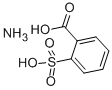
Because it contains carboxyl and sulfonyl groups, 2-sulfonylsporin ammonium salt can perform various functions such as monodentate, bidentate, chelate, and bridging, and can also act as a donor and acceptor for forming hydrogen bonds. Therefore, the chemistry of 2-sulfonylsporin ammonium salt has been extensively studied.
0.25 mmol of ammonia, 0.112 g (0.5 mmol) of sodium 2-sulfobenzoate (3-NaHsb), 0.078 g (0.50 mmol) of 2,2-bipyridine (2,2-bipy), and 20 mL of water were added to 30 mL of Teflon tubing sealed in a stainless steel reactor, and the reaction was carried out for 1 d in an oven at 423 K. The solution was cooled down to room temperature. A dark red solution was obtained and filtered; the filtrate was slowly evaporated at room temperature and dark red bulk crystals were obtained in about 3 months in 54% yield (147 mg of 2-sulfosporin ammonium salt). Elemental analysis (based on the chemical formula C7H9NO5S) showed that the experimental values matched the theoretically calculated values.
o-Sulfobenzoic acid (monoammonium salt) [6939-89-5] M 219.5. Crystallise the salt from water.