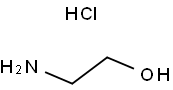
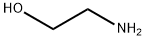
Ethanolamine hydrochloride is utilized as a carbon and nitrogen source by bacteria that differs phylogenetically. It exists as phosphotidylethanolamine in the bacterial and mammalian cell membrane. Ethanolamine-ammonia lyase is responsible for the degradation of ethanolamine into acetaldehyde and ammonia. Ethanolamine is known to positively support lipid accumulation in photosynthetic organism model.
General procedure for the synthesis of ethanolamine hydrochloride from 2-aminoethanol:
Reagents and reaction conditions: 36% concentrated hydrochloric acid, room temperature.
Operating steps:
1. 15.0 g of 2-aminoethanol was weighed and added to three reaction flasks.
2. 27.0 g of 36% concentrated hydrochloric acid was added dropwise at a constant rate through a dropping funnel under stirring conditions, and the reaction temperature was controlled to be no more than 40 °C. 3.
3. after completion of the dropwise addition, the reaction mixture was continued to be stirred for 20 minutes until the pH was about 2 and the reaction was terminated.
4. remove water from the reaction system by concentration under reduced pressure until a very small amount of water remains.
5. A small amount of toluene was added and the residual water was further removed by azeotropic distillation.
6. The reaction mixture was rapidly cooled to give 23.7 g of a slightly light brown solid product, ethanolamine hydrochloride (M-07), in 99% yield.
[1] Bulletin des Societes Chimiques Belges, 1984, vol. 93, # 10, p. 903 - 912
[2] Patent: CN105585607, 2016, A. Location in patent: Paragraph 0107; 0108; 0109; 0110
[3] Green Chemistry, 2016, vol. 18, # 9, p. 2834 - 2842
[4] Green Chemistry, 2017, vol. 19, # 13, p. 3152 - 3163