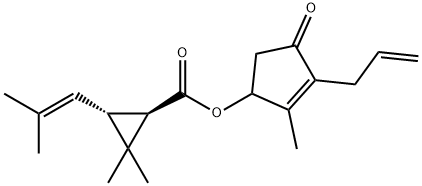
Bioallethrin is an insecticide. It has a low aqueous solubility, is volatile and would not normally be expected to leach to groundwater. It is moderately persistent in soil and, under certain conditions, could be persistent in water. It is moderately toxic to mammals, is an endocrine disrupter and an eye irritant. Bioallethrin is highly toxic to fish but less so to birds and honeybees.
Bioallethrin is produced through a multi-step synthesis that begins with the preparation of allyl alcohol ketone, typically derived from 2-methylfuran via a Vickers reaction. This intermediate undergoes a series of transformations including the Gattermann reaction, furfural translocation, and isomerization to yield the desired ketone structure. The final step involves esterification with chrysanthemic acid or its derivatives to form bioallethrin, a mixture of two active stereoisomers of allethrin.
ChEBI: Bioallethrin is a partly enantiopure variant of allethrin consisting of a mixture of two allethrin isomers (1R,trans;1R and 1R,trans;1S) in an approximate ratio of 1:1. Widely registered mosquito adulticide and spatial repellent. Bioallethrin is a synthetic pyrethroid used as a pesticide against household pest insects such as mosquitoes, houseflies and cockroaches.
Non-systemic, contact and stomach action with a rapid knock-down effect. Sodium channel modulator.