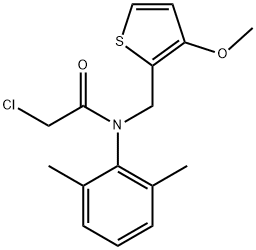
It is mainly used for pre-emergence control of annual grass weeds and most broadleaf weeds in paddy fields, and is particularly effective against barnyard grass (before and during the two-leaf stage). The dosage is 180~270g(ai)/hm2 [12~18g(ai) per mu].
ChEBI: Thenylchlor is an anilide.
Thenylchlor is commercially produced via a process that begins with the preparation of the substituted acetanilide intermediate by N-alkylation of 2,6-dimethylaniline with 3-methoxy-2-(chloromethyl)thiophene under phase-transfer conditions. The key acylation follows, reacting the secondary amine with chloroacetyl chloride in dichloromethane in the presence of triethylamine to form the amide linkage, minimising over-acylation through controlled addition.
Absorbs through roots, blocks protein synthesis and so inhibits cell division. Inhibition of very long chain fatty acids (VLCFA, inhibition of cell division)
14C-Thenylchlor (NSK-850) is degraded in three kinds
of paddy soil with a half-life of 1-3 weeks after
application. Two major metabolites are identified as N-
acetyl and N-hydroxylmethylcarbonyl derivatives which
are derived from the replacement of the chlorine atom
of thenylchlor by hydrogen and hydroxyl groups,
respectively.