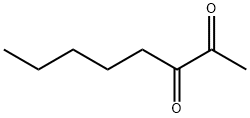
2,3-Octanedione has a “warmed-over” flavor (off-flavor).
Reportedly present in fish, turkey, chicken, beef, lamb, mutton, coffee, tea, peanut, mushroom, prickly pear
and lavage leaf.
The title Octane-2,3-dione is used on a very limited
scale in perfume compositions, mainly as a
trace component in topnote compositions,
}vhere it gives interesting effects in the presence
of Civet and Phenylacetic acid, or certain
Labdanum products, etc. It is also of good
use in Ylang Ylang compositions and in many
other flower bases.
ChEBI: 2,3-Octanedione is an alpha-diketone.
Octane-2,3-dione is prepared in three steps. 1) Preparation of composite catalyst: 5-Methoxytriazole is refluxed with chlorobenzene and acetonitrile to give component 1 (5-methoxy-triphenyl-1,2,4-triazolium salt). 5-Methoxythiazole is refluxed with benzyl chloride and acetonitrile to give component 2 (5-methoxy-2-benzylthiazolium salt). The two are mixed 1:1 to form the composite catalyst. 2) Preparation of Fe3+-Fe2+ redox system: Ferrous sulfate and sulfuric acid react with hydrogen peroxide. 3) Preparation of octane-2,3-dione: Acetaldehyde and hexanal are coupled using the composite catalyst. The crude product is distilled. The distillate is oxidized in the presence of the Fe3+-Fe2+ redox system in a reaction-distillation apparatus. The distillate is collected as the product.