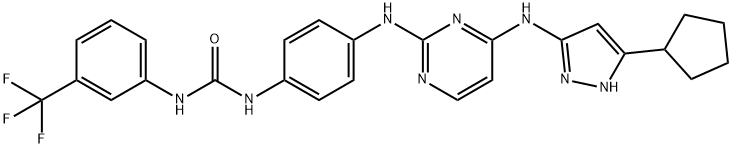
CD532 is a potent Aurora A kinase inhibitor with an IC50 of 45 nM. CD532 has the dual effect of blocking Aurora A kinase activity and driving degradation of MYCN. CD532 also can directly interact with AURKA and induces a global conformational shift. CD532 can be used for the research of cancer[1][2].
ChEBI: CD532 is a member of the class of phenylureas that is urea with 4-[[4-[(5-cyclopentylpyrazol-3-yl)amino]pyrimidin-2-yl]amino]phenyl and 3-[3-(trifluoromethyl)phenyl substituents at positions N1 and N3. It has a role as an antineoplastic agent. It is an aminopyrimidine, a secondary amino compound, a member of pyrazoles, a member of cyclopentanes and a member of phenylureas.
Cell permeable: yes', 'Primary Target
Aurora A', 'Reversible: yes', 'Secondary Target
MYCN
CD532 (25 mg/kg; i.p. twice weekly for 3 weeks) decreases the tumor volume and increases survival in mice with subcutaneous sonic hedgehog (SHH)-subtype medulloblastoma[1].
CD532 (60 mg/kg; i.p. for 2 days) decreases the level of MYCN protein in MYCN-amplified neuroblastoma xenografts[1].
CD532 (20 mg/kg; i.p.) shows a serum half-life of ~1.5 hours and AUC0-24 of 27 μMh in mice[1].
| Animal Model: | Homozygous nu/nu mice with SHH-subtype MYCN-expressing medulloblastoma[1] |
| Dosage: | 25 mg/kg |
| Administration: | I.p. twice weekly for 3 weeks |
| Result: | Decreased the level of MYCN protein and tumor volume and increases survival. |
[1] Gustafson WC, et, al. Drugging MYCN through an allosteric transition in Aurora kinase A. Cancer Cell. 2014 Sep 8;26(3):414-427. DOI:
10.1016/j.ccr.2014.07.015[2] Lee JK, et, al. N-Myc Drives Neuroendocrine Prostate Cancer Initiated from Human Prostate Epithelial Cells. Cancer Cell. 2016 Apr 11;29(4):536-547. DOI:
10.1016/j.ccell.2016.03.001