Using 2,3-dicarboxylic acid pyridine as a starting material, esterification is first performed to generate dimethyl pyridinedicarboxylate. Then, the corresponding methyl ester is reduced using a mixed reagent consisting of sodium borohydride and anhydrous calcium chloride. The reaction product can be directly subjected to the next chlorination reaction without purification. The chlorination product is reacted at room temperature with acetonitrile as solvent and anhydrous potassium carbonate as base to obtain the cyclized product 6,7-dihydro-pyrrolo[3,4-b]pyridine. This method is novel in design, has mild reaction conditions, and is simple to process, making it particularly suitable for industrial application and enriching the synthetic methods for pyrrolopyridine cyclic compounds.
The preparation route of 6,7-dihydro-5H-pyrrolo[3,4-b]pyridine is shown in the figure below:
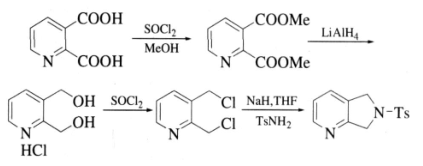
Figure 1 Preparation route of 6,7-dihydro-5H-pyrrolo[3,4-b]pyridine

![6,7-Dihydro-5H-pyrrolo[3,4-b]pyridine Structure](/CAS/GIF/147739-88-6.gif)
![6,7-Dihydro-5H-pyrrolo[3,4-b]pyridine pictures](/ProductImageEN/2024-01/Small/ee0b8f29-d060-43a8-8309-afec5cd08b2a.png)
![6,7-Dihydro-5h-pyrrolo[3,4-b]pyridine pictures](/ProductImageEN/2022-02/Small/4951bf3d-4dfd-4f61-b804-9563269eca37.jpeg)
![6,7-Dihydro-5H-pyrrolo[3,4-b]pyridine pictures](/ProductImageEN/2021-11/Small/456376d1-acac-4e45-a22c-bcc433d6b188.png)