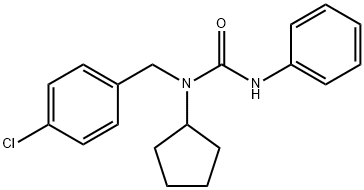
Pencycuron is a phenylurea fungicide. It is virtually insoluble in water but will dissolve in most common organic solvents. It is volatile and not expected to leach to groundwater. It is moderately persistent in soils and slightly more so in water systems. It is not highly toxic to mammals but is moderately toxic to birds, most aquatic organisms, honeybees and earthworms.
N-((4-Chlorophenyl)methyl)-N-cyclopentyl-N'-phenylurea is an urea based fungicide developed specifically against the plant pathogen Rhizoctonia solani for which it was developed. N-((4-Chlorophenyl)methyl)-N-cyclopentyl-N'-phenylurea has also been used for controlling sheath blight of ri ce.
Pencycuron is an urea based fungicide developed specifically against the plant pathogen Rhizoctonia solani for which it was developed. Pencycuron has also been used for controlling sheath blight of rice.
Pencycuron is used for the control of diseases caused by Rhizoctonia
solani and Pellicularia spp. in potatoes, rice (sheath blight), cotton,
sugar beet, vegetables, ornamentals and turf. It can be applied to foliage
or by incorporation into the soil.
ChEBI: A member of the class of ureas carrying 4-chlorobenzyl and cyclopentyl substituents at position 1 and a phenyl substituent at position 3. A fungicide used to control diseases caused by Rhizoctonia solani and Pellicularia spp. It i
not highly toxic to mammals but is moderately toxic to birds, most aquatic organisms, honeybees and earthworms.
Pencycuron is synthesised through a relatively straightforward process involving the formation of a phenylurea structure. The key production step includes the reaction of 4-chlorobenzylamine, cyclopentylamine, and phenyl isocyanate or related derivatives to form N-[(4-chlorophenyl)methyl]-N-cyclopentyl-N′-phenylurea, the active ingredient in pencycuron. This condensation reaction typically occurs under controlled temperature and solvent conditions to ensure high yield and purity.
Pencycuron is a non-systemic phenyl urea herbicide effective against pathogens such as Rhizoctonia solani and Pellicularia spp. Pencycuron acts by inhibiting cell division.
Fungicide: Pencycuron is a non-systemic fungicide with specific
control against fungicidal diseases (Rhizoctonia solani and
Pellicularia) in potatoes, sugar beets, rice, cotton and ornamentals.
Not currently registered in the U.S. Used in most
European countries. There are more than 30 global suppliers.
BAY® NTN-19701; BAYER® NTN-19701;
MONCEREN®; NTN-19701®; PENCYCURONE®
Non-systemic with protective action. Inhibition of mitosis and cell division.
The metabolic profiles of pencycuron in fungus,
hydrolysis, mammals, photodecomposition, plants, and
soils are illustrated. Both tolerant and sensitive fungal
species Rhizoctonia solani metabolize pencycuron to
give cis- and trans-3-hydroxycyclopentyl pencycurons
which are less active than pencycuron.
Pencycuron is a very stable compound. Its DT50 in water at pH 4 is 280
days and at pH values 7 and 9 the estimated DT50 values are 22 and 17
years, respectively. It is photolysed in water and on soil surfaces.