
朱砂精酸
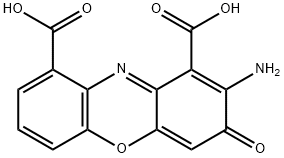
朱砂精酸 性质
| 熔点 | >300°C |
|---|---|
| 密度 | 1.79 |
| 储存条件 | 2-8°C |
| 溶解度 | 二甲基亚砜:≥4mg/mL |
| 形态 | 粉末 |
| 颜色 | 红色至深红色 |
| 稳定性 | 从购买之日起 2 年内保持稳定。 DMSO 或 DMF 溶液可在 -20°C 下保存长达 1 个月。 |
| InChI | 1S/C14H8N2O6/c15-10-6(17)4-8-12(9(10)14(20)21)16-11-5(13(18)19)2-1-3-7(11)22-8/h1-4H,15H2,(H,18,19)(H,20,21) |
| InChIKey | FSBKJYLVDRVPTK-UHFFFAOYSA-N |
| SMILES | NC1=C(C(O)=O)C2=Nc3c(OC2=CC1=O)cccc3C(O)=O |
朱砂精酸 用途与合成方法
|
mGluR4
|
Cinnabarinic acid (0-100 μM) does not activate mGlu1, mGlu2, mGlu5, mGlu6, mGlu7, and mGlu8 receptors as shown by measurements of [ 3 H]InsP formation. In contrast, cinnabarinic acid acts as a partial agonist of mGlu4 receptors by increasing [ 3 H]InsP formation by approximately 35% at 100 μM, which is 5-fold less efficacious than ACPT-I in activating mGlu4 receptors in HEK293 cells transiently transfected with rat mGlu1, -2, -4, -5, -6, -7, or -8 receptors. Cinnabarinic acid (0-100 μM) reduces cAMP formation in a concentration-dependent manner with an excellent potency and efficacy. At 30 μM, cinnabarinic acid is effective at 30 μM, and substantially inhibits cAMP formation in cultured cerebellar granule cells.
朱砂精酸 价格(试剂级)
| 更新日期 | 产品编号 | 产品名称 | CAS号 | 包装 | 价格 |
|---|---|---|---|---|---|
| 2026-09-15 | HY-W011417R | 朱砂精酸 | 606-59-7 | 1 mg | 1800 |
| 2026-09-15 | HY-W011417R | 朱砂精酸 | 606-59-7 | 5 mg | 3600 |
