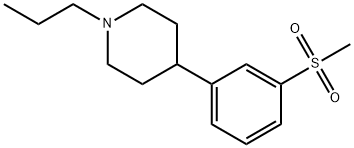
[1] FREDRIK PETTERSSON*. Synthesis and Evaluation of a Set of 4-Phenylpiperidines and 4-Phenylpiperazines as D2 Receptor Ligands and the Discovery of the Dopaminergic Stabilizer 4-[3-(Methylsulfonyl)phenyl]-1-propylpiperidine (Huntexil, Pridopidine, ACR16)[J]. Journal of Medicinal Chemistry, 2010, 53 6: 2510-2520. DOI:
10.1021/jm901689v[2] SRIDHAR NATESAN. The dopamine stabilizers (S)-(-)-(3-methanesulfonyl-phenyl)-1-propyl-piperidine [(-)-OSU6162] and 4-(3-methanesulfonylphenyl)-1-propyl-piperidine (ACR16) show high in vivo D2 receptor occupancy, antipsychotic-like efficacy, and low potential for motor side effects in the rat.[J]. Journal of Pharmacology and Experimental Therapeutics, 2006, 318 2: 810-818. DOI:
10.1124/jpet.106.102905[3] TINO DYHRING . The dopaminergic stabilizers pridopidine (ACR16) and (−)-OSU6162 display dopamine D2 receptor antagonism and fast receptor dissociation properties[J]. European journal of pharmacology, 2010, 628 1: Pages 19-26. DOI:
10.1016/j.ejphar.2009.11.025[4] KRISTOFFER SAHLHOLM. Pridopidine selectively occupies sigma-1 rather than dopamine D2 receptors at behaviorally active doses.[J]. Psychopharmacology, 2015, 232 18: 3443-3453. DOI:
10.1007/s00213-015-3997-8[5] K SAHLHOLM. The dopamine stabilizers ACR16 and (−)-OSU6162 display nanomolar affinities at the σ-1 receptor[J]. Molecular Psychiatry, 2012, 18 1: 12-14. DOI:
10.1038/mp.2012.3[6] VERONICA FRANCARDO . Pridopidine Induces Functional Neurorestoration Via the Sigma-1 Receptor in a Mouse Model of Parkinson’s Disease[J]. Neurotherapeutics, 2019, 16 2: Pages 465-479. DOI:
10.1007/s13311-018-00699-9[7] DANIEL RYSKAMP . The sigma-1 receptor mediates the beneficial effects of pridopidine in a mouse model of Huntington disease[J]. Neurobiology of Disease, 2017, 97: Pages 46-59. DOI:
10.1016/j.nbd.2016.10.006[8] ARIEL IONESCU. Targeting the Sigma-1 Receptor via Pridopidine Ameliorates Central Features of ALS Pathology in a SOD1G93A Model.[J]. Cell Death & Disease, 2019, 10 3: 210. DOI:
10.1038/s41419-019-1451-2