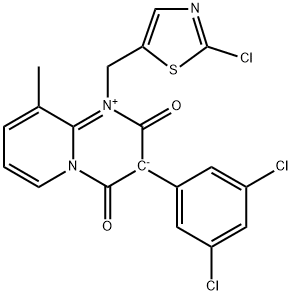
Dicloromezotiaz is an organochlorine zwitterionic, rice insecticide. Little data is currently available regarding its environmental fate, ecotoxicity or impact on human health.
Dicloromezotiaz is a commercial pest control agent. Dicloromezotiaz can provide a useful control tool for lepidopteran pests, with an underexploited mode of action among these pests. A mesoionic insecticide
ChEBI: Dicloromezotiaz is a pyridopyrimidine that is 9-methyl-2,4-dioxo-2H-pyrido[1,2-a]pyrimidine substituted at positions 1 and 3 by (2-chloro-1,3-thiazol-5-yl)methyl and 3,5-dichlorophenyl groups respectively. A mesoionic insecticide used for control of rice hoppers. It has a role as an agrochemical. It is an iminium betaine, an organochlorine insecticide, a dichlorobenzene, a member of 1,3-thiazoles and a pyridopyrimidine.
Dicloromezotiaz is produced through a convergent multistep synthesis that begins with a copper catalysed coupling of dimethyl malonate with an aryl iodide to form an intermediate that is then hydrolysed to the corresponding diacid. In parallel, the second key fragment is prepared by protecting an aminopyrimidine precursor, alkylating it under phase transfer conditions with 2 chloro 5 (chloromethyl)thiazole, and then removing the protecting group to yield the required amine coupling partner. The final step activates the diacid as its diacid chloride and condenses it with the amine fragment in toluene in the presence of triethylamine, affording dicloromezotiaz as a single crystal polymorph
Acts on nicotinic acetylcholine receptors