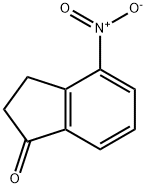
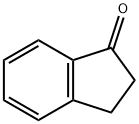
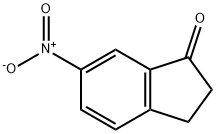
General procedure for the synthesis of 4-nitro-1-indanone and 6-nitro-1-indanone from 1-indanone: To a well-stirred mixture of concentrated sulfuric acid (98%, 13.9 mL) and nitric acid (65%, 2.6 mL) at -10°C, a solution of nitromethane (1.1 mL) with 1-indanone (1.0 g, 7.6 mmol) was slowly added. The rate of addition was controlled so that the temperature increased from -10°C to -5°C in 30 minutes. Stirring of the reaction mixture was continued at this temperature for 15 minutes (tight control of temperature and reaction time is required). Upon completion of the reaction, the mixture was poured into ice water (200 mL) for hydrolysis and the resulting yellow precipitate was collected. The aqueous phase was extracted with dichloromethane (2 x 20 mL) and the organic phase was combined. The organic phase was washed sequentially with potassium bicarbonate solution (2 x 15 mL) and saturated brine (10 mL), dried over anhydrous sodium sulfate and concentrated under reduced pressure. The residue was purified by fast column chromatography using hexane-ethyl acetate (1:0.2) as eluent. Isolation afforded 4-nitro-1-indanone (compound 25, 0.94 g, 80% yield) with a melting point of 98-100 °C (literature value: 100-101 °C).1H NMR (CDCl3) δ ppm: 2.80 (m, 2H, CH2), 3.53 (m, 2H, CH2), 7.61 (m, 1H, H-Ar), 8.08 (d, J = 8.5 Hz, 1H, H-Ar), 8.47 (d, J = 8.3 Hz, 1H, H-Ar). Simultaneous isolation afforded 6-nitro-1-indanone (compound 26, 0.23 g, 20% yield) with a melting point of 73-74 °C (literature value: 72-73 °C).1H NMR (CDCl3) δ ppm: 2.83 (m, 2H, CH2), 3.28 (m, 2H, CH2), 7.61 (d, J = 8.5 Hz, 1H, H-Ar) 8.44 (dd, J = 2.2 Hz, J = 8.5 Hz, 1H, H-Ar), 8.56 (d, J = 2.2 Hz, 1H, H-Ar).