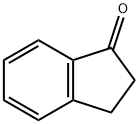
1-Indanone is an important skeletal structure with a wide range of biological activities. Extensive research has demonstrated that 1-indanone derivatives play a significant role in the development of drugs for the treatment of Alzheimer's disease, as well as in anti-diarrhoeal, anti-proliferative, antibacterial, anti-inflammatory and anti-cancer agents[1].
1-Indanone is an oxidation product of indan, a component of fuels, solvents and varnishes. 1-Indanone is also a metabolite of Thalidomide that has been shown to inhibit the attachment of tumor cells to concanavalin A coated plastic surfaces.
1-Indanone is an oxidation product of Indan, a component of fuels, solvents, and varnishes. 1-Indanone is also a metabolite of Thalidomide that has been shown to inhibit the attachment of tumor cells to concanavalin A coated plastic surfaces.
ChEBI: An indanone that consists of 2,3-dihydro-1H-indene substituted by an oxo group at position 1.
Indoleamine 2,3 dioxygenase (IDO) 1 plays an important role in the metabolism of tryptophan and in immune regulation. Removal of IDO1 results in attenuated contact hypersensitivity (CHS) responses.
1-Indanone is produced by cyclization of be{a-Phenylpropionyl chloride in Benzene.
[1] Mei Zuo . (2025). Synthesis, X-ray, DFT and antibacterial activity of a novel 1-indanone derivative. Journal of Molecular Structure, 1339, Article 142422. https://doi.org/
10.1016/j.molstruc.2025.142422