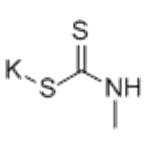
crystalline solid, but often supplied as a brown or yellow aqueous solution
Potassiummethyldithiocarbamate is a herbicide.
Metam-potassium is commercially produced by reacting methylamine with carbon disulfide to form methyldithiocarbamic acid, which is then neutralised with potassium hydroxide to yield the potassium salt.
A concentrated aqueous solution. Clear orange liquid with a pungent rotten-egg odor.
Slowly decomposes generating carbon disulfide and methylamine. Addition of water increases the rate of decomposition.
Potassium N-methyldithiocarbamate slowly decomposes in water to give hydrogen sulfide and methylamine. Dilution increases the rate of decomposition. Acidification increases the rate of decomposition. Reactions with aldehydes, nitrides, and hydrides generate flammable gases. Incompatible with acids, peroxides, and acid halides.
Soil fumigant, binds to oxygen carrying molecules and prevents tissues from using oxygen. Multi-site activity.
Fungicide; Insecticide; Nematicide; Soil sterilent