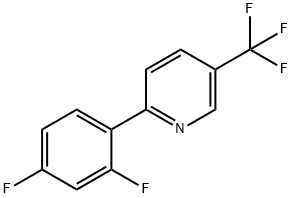
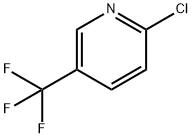
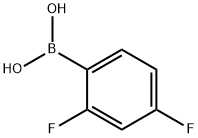
General procedure for the synthesis of 2-(2,4-difluorophenyl)-5-(trifluoromethyl)pyridine from 2-chloro-5-(trifluoromethyl)pyridine and 2,4-difluorophenylboronic acid: To a 100 mL two-necked round-bottomed flask equipped with a magnetic stirrer were added 2-chloro-5-trifluoromethylpyridine (1 equiv), 2,4-difluorophenylboronic acid (1.2 equiv), triphenylphosphine (0.1 equiv), 2 M aqueous potassium carbonate (2.7 eq.) and ethylene glycol dimethyl ether (0.9 M). The reaction mixture was degassed with argon for 15 minutes. Subsequently, palladium acetate (2.5 mol%) was added to the reaction system and degassing was continued for 15 minutes before sealing the reaction system. The reaction mixture was heated to reflux and the progress of the reaction was monitored by thin layer chromatography (TLC, unfolding agent ratio of petroleum ether:ethyl acetate = 90:10). Upon completion of the reaction (usually takes 18-24 hours), the reaction mixture was cooled to room temperature and extracted with dichloromethane (3 x 20 mL). The organic phases were combined, washed sequentially with water (3 × 20 mL) and saturated saline (120 mL), dried over anhydrous sodium sulfate, and the solvent was concentrated under reduced pressure. The crude product was purified by fast column chromatography to afford the target product 2-(2,4-difluorophenyl)-5-(trifluoromethyl)pyridine.
[1] Journal of Organometallic Chemistry, 2015, vol. 776, p. 51 - 59
[2] Journal of Organic Chemistry, 2016, vol. 81, # 16, p. 6988 - 6994
[3] Journal of the American Chemical Society, 2017, vol. 139, # 47, p. 17186 - 17192
[4] Chemistry - A European Journal, 2018, vol. 24, # 44, p. 11314 - 11318