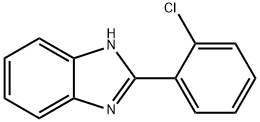
Chlorfenazole is an obsolete fungicide. Little information is available regarding its environmental fate, ecotoxicology or impacts on human health.
Chlorfenazole, also known as 2-(2-Chlorophenyl)-1H-benzimidazole, is a biologically active compound that is commonly used in agriculture. It belongs to the benzimidazole derivative family and has the potential to display anti-parasitic, anti-fungal, or anti-inflammatory properties.
Chlorfenazole production begins with a halogenated benzaldehyde or benzonitrile precursor (e.g., o chlorobenzonitrile or 2 chlorobenzalmalononitrile), which is converted into the key intermediate through condensation with malononitrile or related nucleophiles. This intermediate is then cyclised with o phenylenediamine under acidic or catalytic conditions to form the benzimidazole core. Final steps involve selective functionalisation, typically halogenation or nitrile retention, followed by purification through solvent extraction and recrystallization to yield technical grade chlorfenazole.
A poison by ingestion.
When heated to decomposition it emits
toxic vapors of NOx and Cl-.