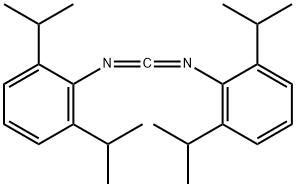
N,N'-Di(2,6-diisopropylphenyl)carbodiimide is an anti-hydrolysis agent. Anti-hydrolysis agent K-1 is a sterically hindered aromatic carbodiimide anti-hydrolysis stabilizer. It reacts with the hydrolysis product carboxylic acid or water, preventing autocatalytic hydrolysis degradation and improving the service life of many polymers, especially enhancing their anti-hydrolysis and hydrolysis stability under harsh operating conditions such as high temperature, humidity, and acid/alkali environments. Its main applications include stabilizing polyester products, polyurethane products (such as PU systems, MDI prepolymers, TPU, adhesives), polyamide-nylon products, and hydrolyzable plastics such as EVA.
A poison by ingestion,intraperitoneal, and inhalation. When heated todecomposition it emits toxic vapors of NOx.
General procedure for the synthesis of N,N'-bis(2,6-diisopropylphenyl)carbodiimide from the compound (CAS: 25348-97-4): to a stirred DippN(H)C(S)N(H)Dipp (7.93 g, 20.0 mmol) and triethylamine (NEt3, 5.58 mL, 40.0 mmol) ethyl acetate (100 mL ) solution, iodine (I2, 5.58 g, 22.0 mmol) was added in batches over 30 min. The reaction mixture was stirred at room temperature for 2 h. Subsequent filtration gave a brown filtrate. The volatile components of the filtrate were removed by distillation under reduced pressure to give a brown solid. The solid was extracted with pentane (4 x 50 mL) and the extract was filtered through a short silica column. The brown filtrate obtained was added to activated copper powder (Cu, 3.00 g, 48.0 mmol). The mixture was stirred at room temperature for 16 h to form a black suspension. The suspension was filtered through silica to obtain a colorless filtrate. The volatile components in the filtrate were removed by distillation under reduced pressure and the solid obtained was dried under vacuum to give the target product N,N'-bis(2,6-diisopropylphenyl)carbodiimide as a colorless crystalline solid. Yield: 4.74 g (65%). The 1H NMR spectrum of the product was in agreement with the data reported by Cowley et al. [24]
[1] Synlett, 2009, # 4, p. 607 - 610
[2] New Journal of Chemistry, 2016, vol. 40, # 9, p. 7627 - 7636
[3] Dalton Transactions, 2008, # 33, p. 4419 - 4423
[4] Polyhedron, 2016, vol. 116, p. 64 - 75
[5] European Journal of Inorganic Chemistry, 2014, # 9, p. 1446 - 1453

![Thiourea, N,N'-bis[2,6-bis(1-methylethyl)phenyl]-](/CAS/20210305/GIF/25348-97-4.gif)


