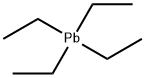
Tetraethyl lead is a highly toxic compound manifesting both acute and chronic effects. These effects are insomnia, hypotension, hypothermia, tremor,weight loss, hallucination, nausea, convulsion and coma. LD50 oral (rats): 12 mg/kg.
colourless to yellow liquid
Tetraethyl lead is a colorless oily liquid. Sweet, slight musty odor. In commerce it is usually dyed red, orange or blue. Tetraethyl lead will decompose in bright sunlight yielding needlelike crystals of tri-, di-, and mono-ethyl lead compounds, which have a garlic odor.
Colorless liquid; burns with orange flame with green margin; refractive index 1.5198; density 1.653 g/mL at 20°C; insoluble in water; slightly soluble in ethanol; soluble in benzene, toluene, gasoline, and petroleum ether.
Tetraethyllead is used as an additive to gasolineto prevent knocking in motors. However,because of its high toxicity and the pollutionproblem, its use in gasoline has been drasticallycurtailed.
Anti-knock motor fuel additive
As a gasoline additive to prevent "knocking" in motors.Its use, however, is reduced drastically because of environmental pollution.
Lead tetraethyl is prepared by heating ethyl chloride in the presence of a catalyst in an autoclave at 40 to 60°C with an alloy of lead and sodium:
Pb + 4Na + 4C2H5Cl → Pb(C2H5)4 + 4NaCl
Also, it can be prepared by the reaction of lead with ethylene and hydrogen in the presence of Ziegler catalyst, triethylaluminum:
Pb + 4C2H4 + 2H2 → Pb(C2H5)4
A poisonous liquid
that is insoluble in water but soluble in organic
solvents. It is manufactured by the reaction
of an alloy of sodium and lead with
1-chloroethane. The product is obtained
by steam distillation. Lead tetraethyl is
used as an additive in internal-combustion
engine fuel to increase its octane number
and thus prevent preignition (knocking).
These compounds were, at one time, the major industrial use
of lead and source of environmental pollution of inorganic
lead combustion products. However, the addition of these
compounds to gasoline in the major industrialized countries
of the world has been discontinued because of the use of
catalysts for the control of the amount of nitrogen oxides in
automobile exhaust. Organolead additives are still being
phased out in many underdeveloped countries, although
the United Nations has called for a global phaseout of
lead in gasoline.
ChEBI: An organolead compound consisting of four ethyl groups joined to a central lead atom.
A colorless liquid with a characteristic odor. Flash point 200°F. Density 14 lb / gal. Insoluble in water. Toxic by inhalation and by skin absorption.
TETRAETHYL LEAD decomposes under UV light. Reacts with fats; reacts violently with oxidizing agents, causing fire and explosion hazards. Attacks rubber [Handling Chemicals Safely 1980. p. 890].
Toxic by ingestion, inhalation, and skin
absorption. Central nervous system impairment.
Questionable carcinogen.
Tetraethyllead is highly toxic by oral route.The LD50 values for rats, mice, andrabbits were all found to be <15 mg/kgwhen administered by the oral, intravenous,subcutaneous, intraperitoneal, and parenteralroutes. It may be absorbed through theskin causing lead poisoning. It is toxic tothe central nervous system. The toxicity,however, is low to moderate by dermal route.It is an acute as well as chronic toxicant.The toxic effects are insomnia, hypotension,tremor, hypothermia, pallor, weight loss,hallucination, nausea, convulsion, and coma.The toxicity of this compound by inhalationroute is also low to moderate. Because of itslow vapor pressure, 0.2 torr at 20°C (68°F),inhalation hazard is relatively low.
LD50 oral (rat): 12 mg/kg
Oral lethal dose (rabbit): 30 mg/kg
LC50 inhalation (rat): 850 mg/m3/1h.
Extremely poisonous; may be fatal if inhaled, swallowed, or absorbed from the skin. Contact may cause burns to skin and eyes. Most symptoms of poisoning are due to the effects of tetraethyllead on the nervous system.
May explode in fires. Decomposes slowly at room temperature and more rapidly at elevated temperatures.
Human poison by an unspecified route. Experimental poison by ingestion, intraperitoneal, intravenous, subcutaneous, and parented routes. Moderately toxic by inhalation and skin contact. Experimental teratogenic and reproductive effects. Questionable carcinogen with experimental carcinogenic data. Mutation data reported. Lead compounds are particularly toxic to the central nervous system. It is a solvent for fatty materials and has some solvent action on rubber as well. The fact that it is a lipoid solvent makes it an industrial hazard because it can cause intoxication not only by inhalation but also by absorption through the skin. Decomposes when exposed to sunlight or allowed to evaporate; forms triethyl lead, which is also a poisonous compound, as one of its decomposition products. May cause elemental lead intoxication by coming in contact with the skin. A combustible liquid when exposed to heat, flame, or oxidizers. Can react vigorously with oxidzing materials. Exposure to air for several days may cause explosive decomposition. To fight fire, use dry chemical, CO2, mist, foam. When heated to decomposition it emits toxic fumes of Pb. See also LEAD COMPOUNDS.
Tetraethyl lead is used as a component of antiknock mixes for gas and as an intermediate in making fungicides; Tetraethyl lead (used as an antiknock compound in gasoline) can also contains impurities, such as ethylene dibromide and ethylene dichloride.
A case-control study of former workers in a TEL-producing
plant found a strong association between exposure to the TEL
manufacturing process and rectal cancer (the odds ratio was
3.7 with 90% confidence limits of 1.3–10.2 for the analysis of
ever/never exposed to TEL). An exposure–response relationship
was noted with a fourfold elevation in the odds ratio at
the high–very high cumulative exposure level. Similar results
were obtained for cancers of the sigmoid colon. These results
suggest to the authors that exposure to the TEL manufacturing
process may have played a causal role in the colorectal
cancer findings in this plant. However, IARC in 2006
has included organolead compounds (TEL and TML), with
Lead and its Compounds in Group 3, not classifiable as to its
carcinogenicity to humans.
UN1649 Motor fuel antiknock mixtures, Hazard Class: 6.1; Labels: 6.1-Poisonous materials.
Its more volatile contaminants can be removed by exposure to a low pressure (by continuous pumping) for 1hour at 0o. Purify it by stirring with an equal volume of H2SO4 (d 1.40), keeping the temperature below 30o, repeating this process until the acid layer is colourless. It is then washed with dilute Na2CO3 and distilled water, dried with CaCl2 and fractionally distilled at low pressure under H2 or N2 [Calingaert Chem Rev 2 43 1926]. It prevents “knocking” in petrol combustion engines. [Milde & Beatty Adv Chem Res 23 306-318 1959, Beilstein 4 H 639.] VERY POISONOUS.
Vapors may form explosive mixture with air. A strong reducing agent. Violent reaction with strong oxidizers, sulfuryl chloride; halogens, oils and fats; rust, potassium permanganate. Decomposes slowly in light and at room temperature, and more rapidly at temperatures above 110�C. Attacks rubber and some plastics and coatings.
Consult with environmental regulatory agencies for guidance on acceptable disposal practices. Generators of waste containing this contaminant (≥ 100 kg/mo) must conform with EPA regulations governing storage, transportation, treatment, and waste disposal. Controlled incineration with scrubbing for collection of lead oxides which may be recycled or land filled. It is also possible to recover alkyl lead compound from wastewaters as an alternative to disposal.