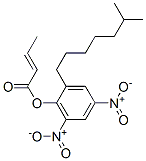
Dinocap is shown in both the 2,4-dinitro and 2,6-dinitro
configurations with 1-methylheptyl and 1-ethylhexyl
chains, respectively, but may also have a 1-propylpentyl
configuration for the “octyl” chain. It is a dark brown
liquid with a bp = 138 to 140 C, vp = 5.3×10⁶ mPa, a
Kow LogP = 4.54, and is almost insoluble (<0.1 mgL1) in
water (5).
Dinotefuran is a dark red viscous liquid with irritating odor, melting point -22.5℃, boiling point 138~140℃(0.05mmHg), it will be decomposed when it exceeds 200℃ under normal pressure. Vapor pressure 3.33×10⁻³ mPa(25℃), KowlgP=4.54(20℃).Henry's constant 1.36×10⁻³Pa- m3/mol(calculated). Relative density 1.10 (20°C). Solubility in water 0.151mg/L. Solubility in other solvents, 2,4-isomer: in acetone, 1,2-dichloroethane, ethyl acetate, n-heptane, methanol, and xylene >250g/L; 2,6-isomer: in acetone, 1,2-dichloroethane, ethyl acetate, and xylene >250g/L, n-heptane 8.5~10.2g/L, methanol 20.4~25.3g/L. Decompose rapidly at light, decompose above 32℃, stable to acid, hydrolyze ester group in alkaline environment. Flash point 67℃.
The commercial production of dinocap involves a multi-step process. It begins with the nitration of 2-(1-methylheptyl)phenol using a nitric acid-sulphuric acid mixture to introduce nitro groups at the 2 and 4 positions, forming 2,4-dinitro-6-(1-methylheptyl)phenol. This intermediate is then esterified with crotonic acid or its derivatives, typically using an acid chloride or anhydride in the presence of a base catalyst in an organic solvent under controlled temperature to yield dinocap.
ChEBI: 2,4-dinitro-6-(octan-2-yl)phenyl (E)-but-2-enoate is an enoate ester obtained by formal condensation of the carboxy group of 3-methylacrylic acid with the phenolic hydroxy group of 2,4-dinitro-6-(octan-2-yl)phenol. It is a C-nitro compound and an enoate ester.
Dark oily liquid. Nearly insoluble in water. Used as a fungicide and acaricide.
Nearly insoluble in water. Hydrolysis of the ester group occurs with alkaline pHs.
A dinitrophenyl derivative.
Fungicide, Acaricide: Dinocap is a foliar fungicide/miticide used to
control powdery mildew. It is applied to limit mites
in apples and grapes crops outside the U.S., mainly in
Europe, the Middle East and northern Africa. It is also
used to control powdery mildew on fruit, vegetables and
ornamentals. DAS, the registrant of dinocap, intends to
support tolerances for dinocap residues in/on apples and
grapes to permit legal importation of these commodities
into the U.S. Not approved for use in EU countries.
Not currently registered in the U.S. There are 17 global
suppliers.
ACTUAL DINOCAP®; ARATHANE®;
CAPRANE®; CR 1639®; CEKUCAP® 25 WP;
CROTOTHANE®; DICAP®; DIKAR®; EZENOAN®;
ISCOTHANE®; ISOCOTHANE®; KARATHANE®[C];
KARATHANE® WD[C]; KARATHENE®[C];
MILDANE®; MILDEX®
Contact with protective and curative action. Respiration inhibitor. Uncoupler of oxidative phosphorylation via disruption of proton gradient.
Poison by ingestion and
intravenous routes. An experimental
teratogen. Other experimental reproductive
effects. Mutation data reported.
Questionable carcinogen with experimental
neoplastigenic data. See NITRATES. When
heated to decomposition it emits toxic
fumes of NOx.
Dinocap shows moderate acute toxicity to mammals
(acute oral LD50 in rats of 1,000 to 5,000 mg/kg) with moderate
dermal irritation but substantial eye irritation in
rabbits (Rohm & Haas MSDS C&P MSDS reference listing;
MDL MSDS database listing). Dinocap is teratogenic
to mice and hamsters at 10 to 100 mg/kg/day (48–51),
although no evidence of teratogenic effects were seen in
rabbits (Rohm & Haas MSDS C&P MSDS reference listing).
Dinocap is classified as “toxic” to fish but is listed as
“nontoxic” to bees (52).
Fungicide; Acaricide; Insecticide