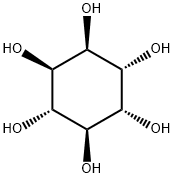
D-chiro-inositol, in its pure form, is a white powder, slightly sweet, and readily soluble in water. Currently, the main method for industrial-scale production is natural extraction. D-chiro-inositol exists in nature as compounds in plants such as legumes and buckwheat, as well as insects (see Table 1). Its precursor, pinol, is also found in various plants, such as bougainvillea, sugar pine, and red sandalwood. Chemical synthesis of chiral inositol has not yet achieved a breakthrough, as the process is cumbersome and costly. Genetic engineering production of D-chiro-inositol involves genetically modifying Bacillus subtilis to convert muscle inositol into D-chiro-inositol; however, this method currently suffers from low bioconversion rates and high costs. The antibiotic kasugamycin, as a precursor of D-chiro-inositol, can be purified after acetylation, representing another production route.
The inositols and their phosphates have been used in the development of metabolically stable insulin mediators, inhibitors, and modulators of important metabolic functions such as glycolysis. Inositols are stable to degradative enzymes in vivo because they lack a hydrolytically labile glycosidic linkage.
ChEBI: Myo-inositol is an inositol having myo- configuration. It has a role as a member of compatible osmolytes, a nutrient, an EC 3.1.4.11 (phosphoinositide phospholipase C) inhibitor, a human metabolite, a Daphnia magna metabolite, a Saccharomyces cerevisiae metabolite, an Escherichia coli metabolite and a mouse metabolite.