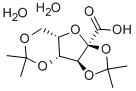
ChEBI: Dikegulac is a member of dioxanes.
The commercial production of dikegulac typically begins with 2-keto-L-gulonic acid. This precursor is reacted with 2,2-dimethoxypropane under elevated temperatures in the presence of a strong acid catalyst, such as sulphuric acid, to form a protected intermediate via acetal formation. This intermediate contains the diacetonide structure characteristic of dikegulac. The reaction mixture is then treated with a base, often sodium hydroxide, to hydrolyse residual esters and neutralise the acid, yielding dikegulac sodium, the usual marketed formulation.
Decreases RNA synthesis, rapidly inhibits amino-acid uptake by cells
Dissolve -DAG in Et2O, filter, dry (MgSO4) it, filter it again and evaporate to give a yellow oil. Addition of one drop of H2O induces crystallisation to the monohydrate, which also forms rhombic crystals on recrystallisation from 95% EtOH/H2O at room temperature. [Flatt et al. Synthesis 815 1979, Reichstein & Grussner Helv Chim Acta 17 311 1934, Takagi & Jeffrey Acta Crystallogr Sect B 34 2932 1978, cf Org Synth 55 80 1976, Beilstein 19/12 V 520.]