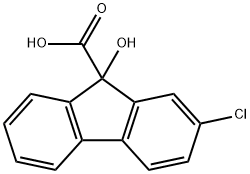
Chlorflurenol is an obsolete herbicide. Data on environmental fate is scant but it does have a moderate aqueous solubility. It has a low mammalian oral toxicity but it does not appear to have been extensively evaluated for chronic health impacts. It is moderately toxic to fish and aquatic invertebrates.
Chlorflurenol is a pesticide.
Chlorflurenol is produced commercially through a multi-step chemical synthesis involving halogenated aromatic compounds. The process typically begins with the preparation of a fluorene derivative, which is then subjected to chlorination to introduce the chlorine atom at the desired position on the aromatic ring. This intermediate is further reacted with functional groups to form the active compound, 2-chloro-9-hydroxyfluorene-9-carboxylic acid. The synthesis requires precise control of reaction conditions to ensure selectivity and yield. Once the active ingredient is obtained, it is formulated into methyl ester derivatives (such as chlorflurenol-methyl) for improved stability and application.
Absorbed by leaves and roots, Auxin inhibitor. Chlorflurenol blocks or slows down the growth and development of growing tips and buds of herbaceous plants.
Herbicide; Plant Growth Regulator