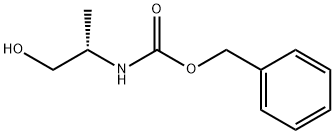
N-Benzyloxycarbonyl-L-alaninol is used as an important organic intermediate. It is an important raw material and intermediate used in organic Synthesis, pharmaceuticals, agrochemicals and dyestuff.
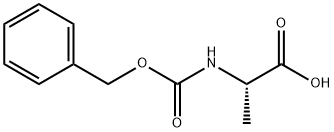
GENERAL METHODS: To a solution of benzyloxycarbonyl-L-alanine (10 mmol) in tetrahydrofuran (THF, 10 mL) was added N,N-diisopropylethylamine (DIPEA, 11 mmol, 1.42 mL) and a solution of 50% propylphosphonic anhydride (T3P) in ethyl acetate (EtOAc) (20 mmol, 6.36 mL) at 0°C with stirring for about 10 minutes. Then sodium borohydride (NaBH4) aqueous solution (10 mmol, 388 mg, dissolved in 0.3 mL of water) was slowly added to the reaction mixture at the same temperature, and the progress of the reaction was monitored by thin-layer chromatography (TLC) until the reaction was completed. Upon completion of the reaction, the solvent was removed by evaporation under reduced pressure, and the crude product was dissolved in ethyl acetate (EtOAc), and the organic phase was washed sequentially with 5% aqueous citric acid (10 mL x 2), 5% aqueous sodium carbonate (Na2CO3) (10 mL x 2), water and saturated saline. The organic phase was dried over anhydrous sodium sulfate (Na2SO4) and the solvent was evaporated under reduced pressure to obtain the target compound.
[1] Antimicrobial Agents and Chemotherapy, 2017, vol. 61, # 3,
[2] Tetrahedron Letters, 2012, vol. 53, # 38, p. 5059 - 5063
[3] Tetrahedron Letters, 1992, vol. 33, # 30, p. 4257 - 4260
[4] Bioorganic and Medicinal Chemistry Letters, 2006, vol. 16, # 7, p. 1975 - 1980
[5] Tetrahedron: Asymmetry, 1992, vol. 3, # 11, p. 1401 - 1410