
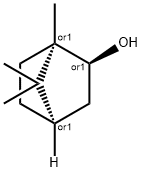
ボルネオール
化学名:ボルネオール
CAS番号.507-70-0
英語名:Borneol
CBNumberCB8697516
MFC10H18O
MW154.25
MOL File507-70-0.mol
别名
ボルネオール (約20%イソボルネオール含む)
rac-(4α*)-1β*,7,7-トリメチルビシクロ[2.2.1]ヘプタン-2β*-オール
rac-(1R*,4R*)-1,7,7-トリメチルビシクロ[2.2.1]ヘプタン-2β*-オール
more
ボルネオール物理性質
| 融点 | 206-209 °C |
| 沸点 | 210 °C(lit.) |
| 比旋光度 | -0.5~+0.5゜(20℃/D)(c=5,C2H5OH) |
| 比重(密度) | 1.011 |
| 蒸気密度 | 5.31 (vs air) |
| 蒸気圧 | 33.5 mm Hg ( 25 °C) |
| FEMA | 2157 | BORNEOL |
| 屈折率 | 1.4831 (estimate) |
| 闪点 | 150 °F |
| 溶解性 | DMSO:30.0(Max Conc. mg/mL);194.49(Max Conc. mM) Ethanol:30.0(Max Conc. mg/mL);194.49(Max Conc. mM) |
| 外見 | powder to crystal |
| 酸解離定数(Pka) | 15.36±0.60(Predicted) |
| 色 | White to Almost white |
| 臭い (Odor) | ジプロピレングリコール中10.00%。パインウッディ カンファー バルサミコ |
| においのタイプ | バルサミコ |
| 水溶解度 | 不溶性 |
| Merck | 14,1338 |
| JECFA Number | 1385 |
show more
| 主な危険性 | F,Xi,Xn |
| Rフレーズ | 11-43-22 |
| Sフレーズ | 16-36/37 |
| RIDADR | UN 1312 |
| WGK Germany | 2 |
| RTECS 番号 | DT5095000 |
| TSCA | TSCA listed |
| 国連危険物分類 | 4.1 |
| 容器等級 | III |
| HSコード | 29061990 |
| 有毒物質データの | 507-70-0(Hazardous Substances Data) |
| 化審法 | (4)-607 |


ボルネオール 化学特性,用途語,生産方法
このような結果となっており、化粧品配合量および通常使用下において、一般に安全性に問題のない成分であると考えられます。
展望
ロンギフォレンの研究はまだ初期段階にありますがその潜在能力は計り知れません今後より多くの高機能材料が開発されれば私たちの生活に革命をもたらす可能性がありますこれらの材料がどのように社会を変えていくのか今後の研究の進展に注目が集まっています説明
l-Borneolum was originally from the Compositae Aenean Blumea balsamifera (L.) DC (Ai Na Xiang). Its crystals were made after being extracted from the fresh leaves of Ai Na Xiang. It is an optical isomer with natural borneol. It’s usually used for making spice the same as natural borneol, synthesized borneol, and so on .Ai Na Xiang is a traditional Chinese medicine alias as Da Feng Ai, Niu Er Ai, etc. It has been recorded firstly in Guang Zhi, “Ai Na Xiang came from the west country and looks like the artemisia.” It has been recorded in many Chinese materia medica books, such as Hai Yao Ben Cao, Ling Nan Cai Yaolu, etc. In Zhong hua Ben cao (Chinese Materia Medica), the literature described it as “Ai Na Xiang (l-borneolum) has the fragrance because it is like the artemisia. It can also be prepared to the borneol, so it is called “Bing Pian Ai.” It is believed that this is the earliest records that Ai Na Xiang was made into borneol . In China, the authentic product area of l-borneolum is in Luodian, Guizhou Province . There are no other plant resources reported for producing l-borneolum in China.
化学的特性
Borneol is a bicyclic terpene alcohol. Borneol is an endo isomer; the corresponding exo isomer is isoborneol:Borneol occurs abundantly in nature as a single enantiomer or, less frequently, as the racemate. (1S,2R,4S)-()-Borneol occurs particularly in oils from Pinaceae species and in citronella oil. (1R,2S,4R)-(+)-Borneol is found, for example, in camphor oil (Ho-Sho oil), rosemary, lavender, and olibanum oils. Borneol is a colorless, crystalline solid. (+)-Borneol has a camphoraceous odor, with a slightly sharp, earthy, peppery note, which is less evident in ()-borneol. Commercial borneol is often levorotatory ([α]20 D 18 to 28 in ethanol) and contains ()-borneol and up to 40% isoborneol.
Borneol is oxidized to camphor with chromic or nitric acid; dehydration with dilute acids yields camphene. Borneol is readily esterified with acids, but on an industrial scale, bornyl esters are prepared by other routes. For example, levorotatory borneol is synthesized industrially from levorotatory pinenes by Wagner–Meerwein rearrangement with dilute acid, followed by hydrolysis of the resulting esters.
Borneol is used in the reconstitution of the essential oils in which it occurs naturally.
物理的性質
Appearance: white translucent flakes, bulk or granular crystals. With a clear aroma, spicy, cool, volatile, black smoke, and yellow flame when lit without residue left. Melting point: 201–205 °C. Soluble in ethanol, chloroform, or ether, almost insoluble in water. Specific optical rotation: 36.5° to 38.5° in 5% (g/mL) ethanol solution, stable under sealed condition at room temperature.Pungent, bitter, slightly cold; heart, spleen, and lung meridians entered. (In Chinese traditional medicine’s opinion)
天然物の起源
Unlike isoborneol, free or esterified borneol has been identified in more than 250 distillates from plants, herbs, leaves or bark; Compositae, Ericaceae, Lauraceae, Labiatea, Rutaceae; natural borneol can be d or l rotatory, but very seldom also racemic; most frequently encountered is the l-borneol characteristic of Compositae, Graminaceae and almost all Pinaceae; d-borneol characteristic of Cupressaceae, Zingiberaceae, lavender, lavandin and spike oils. Reported found in citrus peel oils (orange, lemon, lime), cinnamon leaf, cassia leaf, ginger, coriander seed, laurel, Ocimum basilicum, Thymus vulgaris L. and Curcuma aeruginosa Roxb.使用
Perfumery, esters.定義
ChEBI: A bornane monoterpenoid that is 1,7,7-trimethylbicyclo[2.2.1]heptane substituted by a hydroxy group at position 2.適応症
Sore throat, aphthous, red eyes, purulent ear discharge, convulsions, febrile delirium, sudden faint due to qi depression, stroke, and coma一般的な説明
A white colored lump-solid with a sharp camphor-like odor. Burns readily. Slightly denser than water and insoluble in water. Used to make perfumes.空気と水の反応
Flammable. Insoluble in water.反応プロフィール
Borneol is an alcohol. Flammable and/or toxic gases are generated by the combination of alcohols with alkali metals, nitrides, and strong reducing agents. They react with oxoacids and carboxylic acids to form esters plus water. Oxidizing agents convert them to aldehydes or ketones. Alcohols exhibit both weak acid and weak base behavior. They may initiate the polymerization of isocyanates and epoxides.危険性
Fire risk in presence of open flame.健康ハザード
Fire may produce irritating and/or toxic gases. Contact may cause burns to skin and eyes. Contact with molten substance may cause severe burns to skin and eyes. Runoff from fire control may cause pollution.火災危険
Flammable/combustible material. May be ignited by friction, heat, sparks or flames. Some may burn rapidly with flare burning effect. Powders, dusts, shavings, borings, turnings or cuttings may explode or burn with explosive violence. Substance may be transported in a molten form at a temperature that may be above its flash point. May re-ignite after fire is extinguished.化学性质
ロンギフォレンは卓越した熱安定性や機械的強度を有することが知られていますまた電気的性質や化学的耐性にも優れているため多岐にわたる産業で使用される可能性を秘めていますこれらの特性は特定の化学構造に起因しておりその構造は高度な化学合成技術により設計されます薬理学
The main effects of l-borneolum are to induce resuscitation (with aromatic stimulation), clear stagnated fire (fever feeling), remove nebula to improve eyesight, and relieve swelling and pain. In traditional Chinese medicine, borneol is often used as an envoy drug and combined with other drugs.The modern pharmacological researches showed that l-borneolum can cross the blood-brain barrier (BBB) through increasing cell membrane fluidity, Na+ -K+- ATPase activity, decreasing membrane potential, and regulating intracellular calcium concentration, which is involved in the effect of resuscitation .
The key brain-protective mechanism of l-borneolum and synthetic borneol is closely related to the regulation of P-glycoprotein pathway, lipid peroxidation, and nitric oxide pathway. In addition, it can regulate the calcium pathway, which is the main biological mechanism of “Xin-floating-heart” medicinal property of borneol and resuscitation. Based on the statistical results of strength integral law, it demonstrated that the brain-protective effect of l-borneolum is stronger than synthetic borneol, suggesting that we should prefer l-borneolum for the treatment of cerebrovascular disease .
臨床応用
l-Borneolum is used as a kind of borneol in clinical usage all along, but its clinical usage is fewer than borneol considering its clinical efficacy is weaker than borneol. The main reasons may be the following aspects: the discovery of l-borneolum is later than borneol, and the processing technology of l-borneolum is far behind borneol which leads to high impurities. l-Borneolum has less adverse reactions the same as borneol, including gastrointestinal irritation, reproductive toxicity, and allergic reactions.概要
ロンギフォレンは材料科学のフロンティアを切り開く可能性を持っておりその多機能性により多くの産業での応用が期待されています科学者たちはこれらの新素材の理解を深めより良い未来を構築するために研究を継続しています参考文献
- 日本化粧品工業連合会編(2013)「ボルネオール」日本化粧品成分表示名称事典 第3版,931.
- 有機合成化学協会編(1985)「ボルネオール」有機化合物辞典,974-975.
- ⌃樋口 彰, 他編(2019)「d-ボルネオール」食品添加物事典 新訂第二版,341.
- 日本医薬品添加剤協会編(2021)「dl-ボルネオール」医薬品添加物事典2021,609.
- 堀内 哲嗣郎(2010)「基礎的な合成香料素材」香り創りをデザインする -調香の基礎からフレグランスの応用まで-,252-315.
- 堀内 哲嗣郎(2010)「香料業界で用いる専門用語」香り創りをデザインする -調香の基礎からフレグランスの応用まで-,32-38.
- 奥田 治, 他(2000)「香調の表現および分類」香料と化粧品の科学,51-53.
- 兼井 典子(2003)「香りの化学」化学と教育(51)(2),86-88. DOI:10.20665/kakyoshi.51.2_86.