-
外観
無色~うすい黄色、液体
-
説明
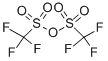
トリフルオロメタンスルホン酸無水物(Tf₂O)は、安価で豊富に存在する多機能なトリフルオロメチル化試薬であり、有機合成、医薬品製造、電子化学、プラスチック、燃料などの分野で広く利用されている。その顕著な求電子性により、Tf2Oは通常、O-求核試薬と反応してトリフルオロメタンスルホン酸エステルを生成し、この種の化合物はクロスカップリング反応において広く使用されるカップリングパートナーとなっている[1]。
-
用途
本製品は主に医農薬中間体などの合成原料(トリフラート化剤)として利用されております。原料からの一環製造、および当社独自のプロセスにより高純度品のご提供が可能です。
-
用途
有機合成(和光試薬時報Vol.62 No.3,p.29(1994))。
-
反応性
トリフルオロメタンスルホン酸無水物(Tf₂O)は、以下の反応に利用することができる:
(1)イソコハク酸無水物は、Tf₂Oおよび2-クロロピリジン(2-ClPy)の相乗作用下で、アシルクロリドや各種アミンと反応し、キナゾリノン誘導体を生成する。
(2)穏やかな反応条件下で、マグネシウムアルコキシドをTf₂Oまたはトリフルオロメタンスルホン酸エステルと反応させると、対応する対称または不斉エーテルが得られる。
(3)Tf2Oとトリエチルアミンは、アルデヒドオキシム(芳香族、複素環、脂肪族および環状脂肪族アルデヒドオキシムを含む一連の化合物)をニトリル化合物へと変換することができる。
(4)Tf2Oは、様々な金属基質と反応して金属トリフルオロメタンスルホン酸塩を生成する。
-
説明
Trifluoromethanesulfonic anhydride, also known as triflic anhydride, has proven to be an extraordinary reagent for a broad range of transformations. As a commercially and readily available reagent, It has been widely used in synthetic chemistry due to its high electrophilicity. Given its high affinity towards O-nucleophiles, reaction with alcohols, carbonyls, sulfur phosphorus- and iodine oxides towards the formation of the corresponding triflates is strongly favored. As one of the premier leaving groups in organic chemistry, the generated triflates then open the door to various downstream transformations, including (but not limited to) substitution reactions, cross-coupling processes, redox reactions, and rearrangements[1-2].
-
化学的特性
clear colorless to light brown liquid
-
使用
Trifluoromethanesulfonic Anhydride is a strong electrophile used in chemical synthesis for introducing the triflyl group.
-
危険性
May be corrosive to metals. Harmful if swallowed. Causes severe skin burns and eye damage.
-
合成
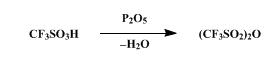
The synthesis of Trifluoromethanesulfonic anhydride is as follows:
A dry, 100-ml., round-bottomed flask is charged with 36.3 g. (0.242
mole) of trifluoromethanesulfonic acid (Note 1) and 27.3 g. (0.192 mole)
of phosphorus pentoxide (Note 2). The flask is stoppered and allowed to
stand at room temperature for at least 3 hours. During this period the
reaction mixture changes from a slurry to a solid mass. The flask is
fitted with a short-path distilling head and heated first with a stream
of hot air from a heat gun and then with the flame from a small burner.The flask is heated until no more trifluoromethanesulfonic anhydride
distills, b.p. 82–115°, yielding 28.4–31.2 g. (83–91%) of the anhydride,
a colorless liquid. Although this product is sufficiently pure for use
in the next step, the remaining acid may be removed from the anhydride
by the following procedure. A slurry of 3.2 g. of phosphorus pentoxide
in 31.2 g. of the crude anhydride is stirred at room temperature in a
stoppered flask for 18 hours. After the reaction flask has been fitted
with a short-path distilling head, it is heated with an oil bath,
yielding 0.7 g. of forerun, b.p. 74–81°, followed by 27.9 g. of the pure
trifluoromethanesulfonic acid anhydride, b.p. 81–84° .
-
参考文献
[1] Yao Ouyang, Prof. Dr. F.-L. Q.; Dr. Xiu-Hua Xu. (2018). Trifluoromethanesulfonic Anhydride as a Low-Cost and Versatile Trifluoromethylation Reagent. Angewandte Chemie, 130 23, 7042–7045. https://doi.org/10.1002/ange.201803566
-
貯蔵
Store in a cool, dry, wellventilated area. Moisture sensitive.
-
純化方法
It can be freshly prepared from the anhydrous acid (11.5g) and P2O5 (11.5g, or half this weight) by setting aside at room temperature for 1hour, distilling off volatile products then distil it through a short Vigreux column. It is readily hydrolysed by H2O and decomposes appreciably after a few days to liberate SO2 and produce a viscous liquid. Store it dry at low temperatures. [Burdon et al. J Chem Soc 2574 1957, Beard et al. J Org Chem 38 373 1973, Beilstein 3 IV 35.]