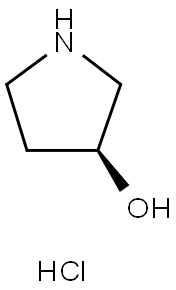
Chemical Properties
almost white crystalline powder
Uses
(S)-3-Hydroxypyrrolidine Hydrochloride is a useful intermediate for the synthesis of Asimadoline Hydrochlorine (A788250), used in the treatment of IBS, a disorder associated with pain and altered bowel function.
Production Methods
(S)-3-hydroxypyrrolidine has been synthesized from L-malic acid or L-glutamic acid in low overall yield or from special optically active precursors such as 4-halo-3-hydroxybutanes or 4-halo-3-hydroxybutyl nitriles; and asymmetric syntheses including hydroboration of N-substituted 3-pyrroline and enzymatic reduction of N-benzyl-3-pyrrolidinone require either special reagents or expensive starting materials.
[4]
Synthesis
(3S)-N-benzyl-3-hydroxypyrrolidine-2,5-dione (100g), added to a 1L high-pressure reactor, add ethanol 500mL, add 10% palladium carbon (58% water content, model D10H5A, Shaanxi Ruike New Materials Co., Ltd.) 5g, through the hydrogen, keep the pressure of the reaction system 0.5MPa, slowly raise the temperature to 70 , the reaction for 5 hours. The reaction was completed by central control, filtered to recover the palladium carbon, concentrated the solvent, added isopropanol (200 mL) to the residue and stirred to dissolve completely, added concentrated hydrochloric acid (45 mL, 12M, 1.1eq) dropwise, stirred overnight at room temperature, and filtered to obtain a white solid, i.e., 51g of (S)-3-pyrrolidinol hydrochloride, with 85% yield and 99.1% purity.
References
[1] Patent: EP2803664, 2014, A1. Location in patent: Paragraph 0153; 0154
[2] Patent: US2015/5282, 2015, A1. Location in patent: Paragraph 0224; 0225
[3] Patent: CN105646321, 2016, A. Location in patent: Paragraph 0031; 0032
[4] Li, Z., Feiten, H.-J., Chang, D., Duetz, W. A., van Beilen, J. B., & Witholt, B. (2001). Preparation of (R)- and (S)-N-Protected 3-Hydroxypyrrolidines by Hydroxylation with Sphingomonas sp. HXN-200, a Highly Active, Regio- and Stereoselective, and Easy to Handle Biocatalyst. The Journal of Organic Chemistry, 66 25, 8424–8430.
https://doi.org/10.1021/jo015826d