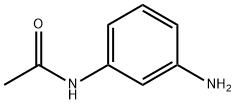
Chemical Properties
light brown crystalline powder
Uses
3'-Aminoacetanilide is mainly used as reaction intermediates dyes and disperse dyes.
General Description
Gray solid.
Air & Water Reactions
Soluble in water.
Reactivity Profile
Amines are chemical bases. They neutralize acids to form salts plus water. These acid-base reactions are exothermic. The amount of heat that is evolved per mole of amine in a neutralization is largely independent of the strength of the amine as a base. Amines may be incompatible with isocyanates, halogenated organics, peroxides, phenols (acidic), epoxides, anhydrides, and acid halides. Flammable gaseous hydrogen is generated by amines in combination with strong reducing agents, such as hydrides.
Health Hazard
ACUTE/CHRONIC HAZARDS: When heated to decomposition N1-(3-Aminophenyl)acetamide emits toxic fumes.
Fire Hazard
Flash point data concerning N1-(3-Aminophenyl)acetamide are not available, however, N1-(3-Aminophenyl)acetamide is probably combustible.
Synthesis
m-Nitroacetanilide (1 g, 5.66 mmol) was dissolved in 100 mL of methanol and a catalytic amount of 10% palladium/activated charcoal (~0.015 g) was added. The reaction mixture was cooled via an ice bath and sodium borohydride (1 g, 26.43 mmol) was added in batches. Subsequently, the mixture was stirred vigorously for 1 hour. The reaction process was monitored by thin layer chromatography (TLC) using toluene-acetone (5:2, v/v) as unfolding agent. Upon completion of the reaction, the product was purified by silica gel column chromatography with toluene-acetone (5:2, v/v) as eluent. A white solid product was obtained in 75% yield with a melting point of 86-88 °C. Elemental analysis (C8H10N2O, Mr=150.18) Calculated values: C 63.98%, H 6.71%, N 18.65%; measured values: C 63.76%, H 6.50%, N 18.53%.1H NMR (400 MHz, DMSO-d6) δ: 9.58 (s, 1H, NH), 6.92 (t, 1H, H-2, J = 2.00 Hz), 6.88 (t, 1H, H-4, J = 8.00 Hz), 6.64 (dd, 1H, H-6, J1 = 0.80 Hz, J2 = 8.00 Hz), 6.23 (dd, 1H, H-5, J1 = 1.60 Hz, J2 = 8.00 Hz), 5.00 (bs, 2H, NH2), 1.99 (s, 3H , CH3-CO).13C NMR (100 MHz, DMSO-d6) δ: 167.85 (C=O), 148.85 (C1), 139.85 (C3), 128.75 (C4), 109.04 (C5), 106.93 (C6), 104.67 (C2), 23.98 (CH3-CO).
References
[1] Green Chemistry, 2018, vol. 20, # 1, p. 130 - 135
[2] Supramolecular Chemistry, 2010, vol. 22, # 10, p. 586 - 597
[3] Bioorganic Chemistry, 2014, vol. 57, p. 13 - 29
[4] Chemical & Pharmaceutical Bulletin, 1989, vol. 37, # 3, p. 615 - 617
[5] Journal of Chemical Research, 2006, # 4, p. 223 - 224