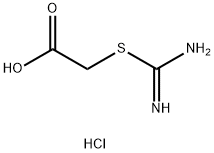
S-Carboxyethylisothiuronium chloride
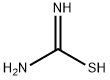
- Product NameS-Carboxyethylisothiuronium chloride
- CAS5425-78-5
- CBNumberCB9855636
- MFC3H7ClN2O2S
- MW170.61
- EINECS231-010-5
- MDL NumberMFCD12028171
- MOL File5425-78-5.mol
- MSDS FileSDS
Chemical Properties
| storage temp. | -20°C |
| form | solution |
| InChI | InChI=1S/C3H6N2O2S.ClH/c4-3(5)8-1-2(6)7;/h1H2,(H3,4,5)(H,6,7);1H |
| InChIKey | DZLYRGFLNXMMIT-UHFFFAOYSA-N |
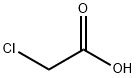
| SMILES | C(C(=O)O)SC(N)=N.Cl |
| NCI Dictionary of Cancer Terms | ATP |
| UNSPSC Code | 41105600 |
Safety
| Symbol(GHS) |

|
| Signal word | Warning |
| Hazard statements | H315-H319-H335 |
| Precautionary statements | P233-P260-P261-P264-P271-P280-P302+P352-P304-P304+P340-P305+P351+P338-P312-P321-P332+P313-P337+P313-P340-P362-P403-P403+P233-P405-P501 |
| Toxicity | A high-energy intermediate essential for normal metabolic processes that require energy (e.g., muscle contraction, active transport). In toxicology, ATP is important as a precursor of the conjugating group in such phase II reactions as sulfate formation and methylation. Toxicants that block ATP formation either by uncoupling mitochondrial oxidative phosphorylation (e.g., dinitrophenol) or by inhibiting mitochondrial electron transport (e.g., cyanide) are important in toxicology. |