Chemical Properties
White to orange to tan crystal or powder
Uses
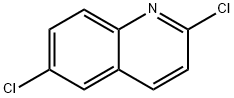
2,6-Dichloroquinoline may be used in the preparation of poly(quinoline-2,6-diyl), via electrochemical polymerization.
Synthesis Reference(s)
The Journal of Organic Chemistry, 67, p. 7884, 2002
DOI: 10.1021/jo016196i
General Description
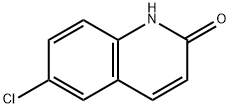
2,6-Dichloroquinoline can be synthesized from 6-chloroquinoline. It can also be prepared from the corresponding 2-vinylaniline.
Synthesis
Synthesis of 2,6-dichloroquinoline: 180 mg of 6-chloroquinolin-2(1H)-one was dissolved in 3 mL of phosphorus oxychloride (POCl3) and the reaction mixture was heated to reflux for 3 h. The reaction was carried out on a rotary evaporator. Upon completion of the reaction, the excess POCl3 was removed by rotary evaporator.After the reaction mixture was cooled to room temperature, the residue was treated with ice water and the precipitated solid was collected by filtration and dried to give the product in the form of a green powder in 90% yield. The synthesis of the compound followed the general method described in claim 5. The theoretical mass-to-charge ratio (m/z) of the compound C9H5Cl2N was 198; the measured value was 198. LC-MS analysis showed that the m/z of the molecular ion peak [M+2]+ was 200.1. 1H NMR (400 MHz, DMSO-d6) δ ppm: 8.04 (1H, d, J = 7.8 Hz), 7.97 (1H, d, J = 8.8 Hz), 7.81 (1H, d, J = 1.9 Hz), 7.68 (1H, dd, J = 9.8 Hz, J = 2.9 Hz), 7.42 (1H, d, J = 8.8 Hz).
References
[1] Patent: US2011/190343, 2011, A1. Location in patent: Page/Page column 27
[2] Journal of Medicinal Chemistry, 2011, vol. 54, # 20, p. 7220 - 7231
[3] Journal of Medicinal Chemistry, 2002, vol. 45, # 14, p. 3130 - 3137
[4] Ann. Inst. Pasteur, 1930, vol. 44, p. 719,737