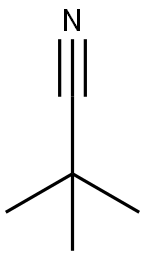
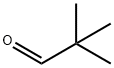
Hydrogenation of trimethylacetonitrile
Trimethylacetonitrile is an aliphatic nitrile compound in which the α-carbon of the nitrile group lacks a hydrogen atom; it can be used in hydrogenation reactions to produce secondary and tertiary amines. The hydrogenation reaction is carried out in the liquid phase using a Pd/C catalyst, at a reaction temperature of 110 °C and a hydrogen pressure of 5 MPa. In the hydrogenation reaction of trimethylacetonitrile with lower-chain aliphatic N,N-dialkylamines (such as diethylamine), dineopentylamine (96.3 wt%) and neopen tylamine (2.8 wt%) were produced, whilst no trineopentylamine was formed.
[5]
Description
Trimethylacetonitrile is a colorless and transparent liquid with high polarity and solubility. Its dielectric constant varies with temperature and frequency. At room temperature, the dielectric constant of trimethylacetonitrile is approximately 37.5, which gradually decreases at high temperatures. The high dielectric constant of trimethylacetonitrile makes it widely used in the field of electrochemistry. For example, in electrochemical reactions, trimethylacetonitrile can be used as a solvent and electrolyte to improve the efficiency and rate of the reaction. At the same time, trimethylacetonitrile can also be used as a dielectric for capacitors, to store charge and energy.
Chemical Properties
CLEAR COLOURLESS LIQUID
Uses
Trimethylacetonitrile used as a solvent and as a labile ligand in coordination chemistry. It is also used as an intermediate in organic synthesis. It is used in the presence of titanium(II) chloride and zinc to undergoes reductive coupling reaction of aromatic and aliphatic ketones including acyclic aliphatic ketones to give the corresponding pinacols.
Application
Trimethylacetonitrile can be used:
As an intermediate compound, it is a product of benzopyrimidine in the preparation of 6-substituted phenanthridines
[1].
As a laboratory research material for the thermodynamic correlation index determination of chemistry, spectroscopic determination and reduction reaction studies with Grignard reagents
[2-4].
Purification Methods
Purify it by a two-stage vacuum distillation and de-gas by the freeze-pump-thaw technique. Store it under vacuum at 0o. TOXIC, use an efficient fume hood. [Beilstein 2 IV 875.]
References
[1] JAN PAWLAS; Mikael B. A One-Pot Access to 6-Substituted Phenanthridines from Fluoroarenes and Nitriles via 1,2-Arynes[J]. Organic Letters, 2002. DOI:10.1021/ol026197c.
[2] T. MOHAMED. Computational (DFT and MP2) and spectral interpretations, normal coordinate analysis, force constants and barriers to internal rotations of Trimethylacetonitrile[J]. Journal of Theoretical & Computational Chemistry, 2016. DOI:10.1142/S0219633616500346.
[3] EDGAR F. WESTRUM JR. Aaron R. Trimethylacetonitrile. Low-temperature heat capacity, vapor pressure, and chemical thermodynamics of the crystalline, liquid, and gaseous phases[J]. The Journal of Physical Chemistry , 1967. DOI:10.1021/j100864a006.
[4] HARRY S. MOSHER; William T M. The Reduction of Trimethylacetonitrile with Grignard Reagents1[J]. Journal of the American Chemical Society, 1951. DOI:10.1021/ja01152a114.
[5] Jiri Krupka, Anna H., Jakub Drahonsky. (2012). Aminocarbene mechanism of the formation of a tertiary amine in nitrile hydrogenation on a palladium catalyst. Reaction Kinetics, Mechanisms and Catalysis, 108 1, 91–105. https://doi.org/
10.1007/s11144-012-0497-2