Uses
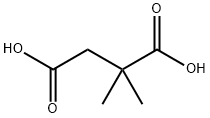
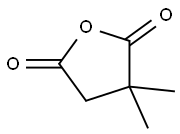
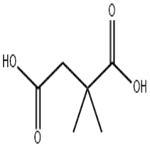
Derivatives of 2,2-dimethylsuccinic acid serve as precursors for the synthesis of specific isoprenoids[1]. The compound acts as a starting material for synthesizing dimethyl 2,2-dimethylsuccinate via esterification with methanol and sulfuric acid, and serves as a ligand in the preparation of the bio-MOF Cu-AD-DMSA alongside copper nitrate and adenine[1][3]. It reacts with (PyH)5[MoOCl4(H2O)]3Cl2 in the presence of base to afford pyridinium salts of the [Mo2O4Cl4(μ2-dmsH)]3− complex[2].
References
[1]
Strunz, G. M., Ya, L. (1992). 2,2-Dimethylsuccinic acid derivatives in isoprenoid synthesis: a 2,2-dimethylvinyl anion equivalent in the synthesis of
ar-atlantone,
ar-turmerone, and prenylated aromatic compounds. Canadian Journal of Chemistry, 70(5), 1317–1322.
https://doi.org/10.1139/v92-169 [2]
Modec, B. (2013). Hydrogen-Bonding in Two Pyridinium Salts of [Mo2O4Cl4(μ2-dmsH)]3−Complex (dmsH− = a Half-Neutralized Form of 2,2-Dimethylsuccinic Acid). Crystals, 3(2), 275–288.
https://doi.org/10.3390/cryst3020275 [3]
Wang, Y., Zhang, F., Yang, Y., Wang, X., Li, L., Li, J., Yang, J. (2025). Optimizing the pore environment in biological metal–organic frameworks through the incorporation of hydrogen bond acceptors for inverse ethane/ethylene separation. Journal of Colloid and Interface Science, 687, 439–448.
https://doi.org/10.1016/j.jcis.2025.02.088