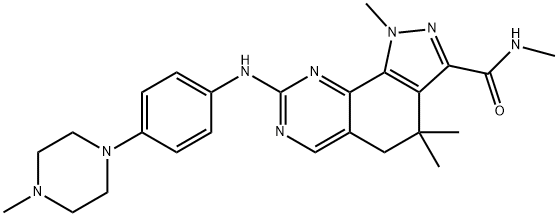
Description
PHA-848125 is an ATP-competitive inhibitor of cyclin-dependent kinases (Cdks) that potently inhibits Cdk2/cyclin A (IC
50 = 45 nM). It is at least 3-fold less potent at Cdks 1, 3, 4, 5, and 7. PHA-848125 is orally available and displays efficacy in suppressing the growth of cancer cells or tumor xenografts in animals.
Uses
PHA-848125 is a cyclin dependent kinase (CDK) inhibitor. Oral PHA-848125 showed antitumor activity via dual targeting of cyclin-dependent kinase and tropomyosin receptor kinase families in human carcinoma cell and xenografted mouse model of carcinoma.
in vivo
Milciclib (PHA-848125; 5, 10, and 15 mg/kg, p.o.) inhibits the growth of tumor in 7,12-dimethylbenz(a) anthracene (DMBA)-induced rat mammary carcinoma model. Milciclib has significant antitumor activity in various human xenografts and carcinogen-induced tumors as well as in disseminated primary leukemia models, with plasma concentrations in rodents in the same range as those found active in inhibiting cancer cell proliferation[2]. Milciclib (PHA-848125; 40 mg/kg) induces a significant tumor growth inhibition in K-RasG12DLA2 mice, and this is accompanied by a reduction in the cell membrane turnover[3].
Enzyme inhibitor
This cyclin kinase-directed inhibitor (FW = 460.57 g/mol; CAS 802539-81- 7, 802540-32-5 (3HCl), 1253645-38-3 (Maleic acid); Solubility: 90 mg/mL DMSO; <1 mg/mL Water), systematically named N,1,4,4-tetramethyl-8-(4- (4-methylpiperazin-1-yl)phenylamino)-4,5-dihydro-1H-pyrazolo[4,3-h] quinazoline-3-carboxamide, targets cyclin A/CDK2 inhibitor with IC50 of 45 nM. PHA-848125-treated cells show cell cycle arrest in G1 and reduced DNA synthesis, accompanied by inhibition of pRb phosphorylation and modulation of other CDK-dependent markers. Cyclin Target Selectivity: Cdk1 (weak, if any), Cdk2 (++), Cdk3 (weak, if any), Cdk4 (weak, if any), Cdk5 (weak, if any), Cdk6 (weak, if any), Cdk7 (weak, if any), Cdk8 (weak, if any), Cdk9 (weak, if any), Cdk10 (weak, if any)
IC 50
cyclin A/CDK2: 45 nM (IC
50); cyclin E/CDK2: 363 nM (IC
50); cyclin H/CDK7: 150 nM (IC
50); cyclin D1/CDK4: 160 nM (IC
50); cyclin B/CDK1: 398 nM (IC
50); TRKA: 53 nM (IC
50)
References
1. brasca mg, amboldi n, ballinari d et al. identification of n,1,4,4-tetramethyl-8-{[4-(4-methylpiperazin-1-yl)phenyl]amino}-4,5-dihydro-1h-pyrazolo[4,3-h]quinazoline-3-carboxamide (pha-848125), a potent, orally available cyclin dependent kinase inhibitor. j med chem. 2009 aug 27;52(16):5152-63.