Preparation
Naphthalene is completely dissolved in a solvent. An appropriate amount of 1-naphthalenesulfonic acid seed crystals are added. The mixture is cooled to 0±5℃, and chlorosulfonic acid is added dropwise under negative pressure while stirring. The addition is completed over 1-2 hours, and then maintained at -2 to 8℃ for another 1.5-3 hours. The molar ratio of naphthalene:chlorosulfonic acid:solvent is 1:1.01-1.10:3.0-3.5. The mixture is cooled to 0±2℃ and filtered. The filter cake is 1-naphthalenesulfonic acid. The filtrate is washed with water, and the phases are separated to obtain the solvent and water-washed acid. The water-washed acid can be used to prepare naphthalene-based high-efficiency water-reducing agents. The 1-naphthalenesulfonic acid and the solvent after water washing are neutralized with 5%-15% NaOH and maintained at 90±5℃ for 10-30 minutes. The neutralized liquid phases are separated to obtain an aqueous solution of sodium 1-naphthalenesulfonate. The solution is cooled to ≤35℃ and crystallized by filtration. The filter cake is sodium 1-naphthalenesulfonate salt.
Description
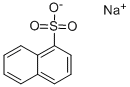
Sodium 1-naphthalenesulfonate (CAS Registry No. 130-14-3) is a valuable regent widely used in the functionalized reduced graphene oxide stabilization of silver nanoparticles. Meanwhile, this is an intermediate in manufacturing 8-Anilino-1-naphthalenesulfonate and 8-p-toluidino-1- naphthalenesulfonate, and many other applications. Sodium 1- and 2-naphthalenesulfonate are mainly synthesized by sulphonation naphthalene with concentrated sulfuric acid then condensation by NaCl. The products formed by this method included sodium 1- and 2-naphthalenesulfonates in various proportions. They were obtained through sulphonation and condensation, respectively. Purifying sodium 1- and 2-naphthalenesulfonates via crystallization in a solvent is very important[1-2].
Chemical Properties
Deliquescent crystals.Soluble
in water, alcohol, and ether. Combustible.
Uses
Sodium 1-naphthalenesulfonate was employed as a detection reagent to investigate ion-pair high-performance liquid chromatographic retention behavior of copper(II)-1-oxa-4,7,10,13-tetraazacyclopentadecane complex. It was also employed as a stationary liquid phase for resolution of dichlorophenol isomers by GC.
Uses
Starting point in the manufacture of
α-naphthol, α-naphthalene sulfonic acid, α-
naphthylaminesulfonic acid; solvent (Na salt) for
phenol in the manufacture of disinfectant soaps.
General Description
Sodium 1-naphthalenesulfonate (SNS) is a highly versatile chemical compound that plays a critical role in industries ranging from construction and textiles to agriculture, detergents, ceramics, and beyond. Its unique properties as a dispersant, surfactant, and water-reducing agent make it a go-to material for improving the performance, efficiency, and quality of countless products and processes.
Flammability and Explosibility
Not classified
Purification Methods
Recrystallise it from water or aqueous acetone [Okadata et al. J Am Chem Soc 108 2863 1986]. [Beilstein 11 IV 521.]
References
[1] Rongrong Li . “Solid–liquid equilibrium of ternary system sodium 1-naphthalenesulfonate + sodium 2-naphthalenesulfonate + water at (283.15, 303.15 and 323.15) K.” Fluid Phase Equilibria 383 (2014): Pages 27-31.
[2] Qiaojun Lu . “Solubility determination and thermodynamic modeling of sodium 1-naphthalenesulfonate and sodium 2-naphthalenesulfonate in six organic solvents from T = (278.15 to 323.15) K and mixing properties of solutions.” Journal of Molecular Liquids 238 (2017): Pages 27-35.