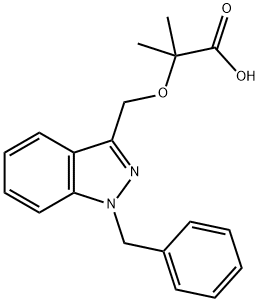
Description
Bindarit is an inhibitor of monocyte chemoattractant protein (MCP) production that is selective for MCP-1/CCL2, MPC-3/CCL7, and MCP-2/CCL8 over other chemokines. It inhibits LPS- or
C. albicans-induced production of MCP-1/CCL2 in isolated human monocytes (IC
50s = 172 and 403 μM, respectively). Bindarit downregulates NF-κB signaling and prevents p65 and p65/p50-mediated MCP-1/CCL2 promoter activation in RAW264.7 cells. It delays the onset of proteinuria and prolongs survival in a mouse model of experimental lupus nephritis when administered at a dose of 50 mg/kg. It prevents LPS-induced increases in MCP-1/CCL2 expression in mouse brain and spinal cord when administered at a dose of 200 mg/kg and reduces the incidence and severity of experimental autoimmune encephalomyelitis (EAE) in mice. Bindarit is also a noncompetitive inhibitor of monocarboxylate transporter 4 (MCT4; K
i = 30.2 μM for the human transporter) that is selective for MCT4 over MCT1.
References
[1] MASSIMILIANO MIROLO. Impact of the anti-inflammatory agent bindarit on the chemokinome: selective inhibition of the monocyte chemotactic proteins.[J]. European cytokine network, 2008, 19 3: 119-122. DOI:
10.1684/ecn.2008.0133[2] M SIRONI. A small synthetic molecule capable of preferentially inhibiting the production of the CC chemokine monocyte chemotactic protein-1.[J]. European cytokine network, 1999, 10 3: 437-442.
[3] EUGENIO MORA. Bindarit: an anti-inflammatory small molecule that modulates the NFκB pathway.[J]. Cell Cycle, 2012, 11 1: 159-169. DOI:
10.4161/cc.11.1.18559[4] CARLA ZOJA. Bindarit retards renal disease and prolongs survival in murine lupus autoimmune disease[J]. Kidney international, 1998, 53 3: Pages 726-734. DOI:
10.1046/j.1523-1755.1998.00804.x[5] SHUJUN GE. The CCL2 synthesis inhibitor bindarit targets cells of the neurovascular unit, and suppresses experimental autoimmune encephalomyelitis.[J]. Journal of Neuroinflammation, 2012: 171. DOI:
10.1186/1742-2094-9-171[6] YUYA FUTAGI . Identification of a selective inhibitor of human monocarboxylate transporter 4[J]. Biochemical and biophysical research communications, 2018, 495 1: Pages 427-432. DOI:
10.1016/j.bbrc.2017.10.025