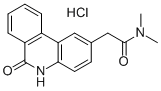
Description
PJ-34 HCl (344458-15-7) is a potent and selective inhibitor of PARP1 and 2. EC50 = 20 nM.1Reduces ischemia reperfusion injury in a mouse model.2 Displays anti-inflammatory effects in a transient focal cerebral ischemia mouse model.3 PJ-34 HCl causes PARP1 independent, p21 dependent mitotic arrest.4
Uses
A poly adenosine diphosphate-ribose polymerase inhibitor, attenuates chromate-induced nephrotoxicity. PJ-34 has a lethal effect on breast cancer cells, both in vitro and in vivo, in particular on breast cancer MCF-7.
Uses
PJ-34 hydrochloride hydrate has been used:
- as a poly(ADP-ribose) polymerase (PARP) inhibitor 1 in rats to test the effect of PAPR1 in neuropathic pain
- as a component of protein extraction buffer to enable visualization of the high-molecular-weight smear of PARylated proteins in various cell samples
- as PARP inhibitor in murine MLE-12 epithelial cell line
Definition
ChEBI: PJ34 hydrochloride is a hydrochloride salt prepared from equimolar amounts of PJ34 and hydrochloric acid. It has a role as an angiogenesis inhibitor, an anti-inflammatory agent, an antiatherosclerotic agent, an antineoplastic agent, an apoptosis inducer, a cardioprotective agent, an EC 2.4.2.30 (NAD(+) ADP-ribosyltransferase) inhibitor and a neuroprotective agent. It contains a PJ34(1+).
General Description
A cell-permeable, water-soluble phenanthridinone-derivative that acts as a potent inhibitor of poly(ADP-ribose) polymerase (PARP; EC
50 = 20 nM). Shown to be about 10,000 times more potent than the prototypical PARP inhibitor, 3-Aminobenzamide (Cat. No.
165350; EC
50 = 200 μM). Does not act as an antioxidant at higher concentrations (1 μM to 10 mM). Exhibits neuroprotection in
in vivo and
in vitro models of stroke. Also available as a 20 mM solution in H
2O(Cat. No.
528151).
Biological Activity
Potent inhibitor of poly(ADP-ribose) polymerase (PARP) (EC 50 = 20 nM). ~ 1000-fold more potent than 3-Aminobenzamide . Protects primary neuronal cells from oxygen-glucose deprivation in vitro and reduces infarct size following focal cerebral ischemia in vivo .
Biochem/physiol Actions
Cell permeable: yes
References
[1] ROBERTO PELLICCIARI PROF. On the Way to Selective PARP-2 Inhibitors. Design, Synthesis, and Preliminary Evaluation of a Series of Isoquinolinone Derivatives[J]. ChemMedChem, 2008, 3 6: 914-923. DOI:
10.1002/cmdc.200800010[2] ROBERT S. CRAWFORD MD . Postischemic poly (ADP-ribose) polymerase (PARP) inhibition reduces ischemia reperfusion injury in a hind-limb ischemia model[J]. Surgery, 2010, 148 1: Pages 110-118. DOI:
10.1016/j.surg.2009.12.006[3] M HADDAD. Anti-inflammatory effects of PJ34, a poly(ADP-ribose) polymerase inhibitor, in transient focal cerebral ischemia in mice[J]. British Journal of Pharmacology, 2009, 149 1: 23-30. DOI:
10.1038/sj.bjp.0706837[4] DANA L. MADISON James R L Daniel Stauffer. The PARP inhibitor PJ34 causes a PARP1-independent, p21 dependent mitotic arrest[J]. DNA Repair, 2011, 10 10: Pages 1003-1013. DOI:
10.1016/j.dnarep.2011.07.006