Synthesis
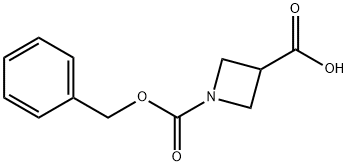
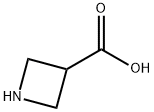
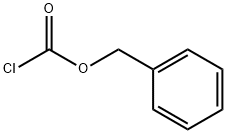
General procedure for the synthesis of 1-(benzyloxycarbonyl)azetidine-3-carboxylic acid from 3-acridinecarboxylic acid and benzyl chloroformate: 3-acridinecarboxylic acid (4.0 g, 39.6 mmol) was dissolved in a 1 N sodium hydroxide solution (40 mL) and the solution was cooled to 0 °C. Under stirring, benzyl chloroformate (5.9 mL, 41 mmol) was slowly added, followed by dropwise addition of additional 1 N sodium hydroxide solution (41 mL). The reaction mixture was stirred vigorously at 0 °C for 16 hours. Upon completion of the reaction, the mixture was acidified to a pH of about 2-3 with 2 N hydrochloric acid.The acidified suspension was extracted with dichloromethane (2 x 100 mL) and the organic layers were combined and dried with anhydrous magnesium sulfate. After filtration, the organic phase was concentrated under reduced pressure to afford the white solid product 1-(benzyloxycarbonyl)azetidine-3-carboxylic acid (9.3 g, 39.6 mmol, 100% yield). The structure of the product was confirmed by 1H NMR (400 MHz, CDCl3): δ 7.37-7.29 (5H, m, Ar-H), 5.10 (2H, s, CH2Ph), 4.21 (4H, d, J = 7.5 Hz, NCH2), 3.43 (1H, quintuple peak, J = 7.5 Hz, CH).
References
[1] Beck A, et al. Strategies and challenges for the next generation of antibody-drug conjugates. Nat Rev Drug Discov. 2017;16(5):315-337. DOI:
10.1038/nrd.2016.268[2] Nalawansha DA, et al. PROTACs: An Emerging Therapeutic Modality in Precision Medicine. Cell Chem Biol. 2020;27(8):998-985. DOI:
10.7554/eLife.57277