Synthesis

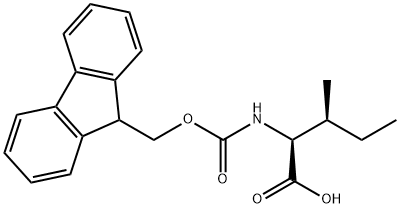
Dissolve 1.05 g (0.008 mol) of L-isoleucine solid in a 10% sodium carbonate solution, stirring until the L-isoleucine solid is fully dissolved. At 20–30 °C, add dropwise a solution of 2.10 g (0.008 mol) of di-9-fluorenemethyloxycarbonyl chloride dissolved in toluene (2–205 mL). Add 3 drops of...
Addition was carried out over 0–60 minutes, followed by stirring at 20–30°C for 1–8 hours. The mixture was then diluted with 30–200 mL of water and extracted with 80 mL of n-butyl acetate to remove excess 9-fluorenemethyloxycarbonyl chloride. The resulting aqueous phase was acidified with concentrated hydrochloric acid to pH 0.5–3.5, and then extracted with 80 mL of n-butyl acetate. The resulting oil phase was washed with water to remove hydrochloric acid, concentrated to remove the n-butyl acetate solvent, and white crystals precipitated. The crystals were filtered and dried to obtain 2.48 g of Fmoc-Ile-OH, with a yield of 87.9% and a melting point of 145–146°C.
Description
Fmoc-Ile-OH is an isoleucine derivative. It is white fine crystalline powder and belong to Fmoc materials. Fmoc-Leu-OH forms flower-like morphology at both low and high concentration under room temperature which changes to small tube-like structure on heating
[1].
Chemical Properties
white fine crystalline powder
Uses
N-Fmoc-L-isoleucine is an unnatural amino acid used for peptidomimetics. It is also used as a pharmaceutical intermediate.
General Description
The product number for this product was previously 04-12-1024.
To obtain a certificate of analysis (CoA) of a lot that begins with the letter “A”, please select the option in the right hand menu “Request a COA for Lot#s starting with A”.
reaction suitability
reaction type: Fmoc solid-phase peptide synthesis
References
[1] N. Gour, B. Koshti, S. Naskar, V. Kshtriya, H. Narode, Self-assembled Structures Formed by Fmoc modified aliphatic amino acids, ChemRxiv, 2021.